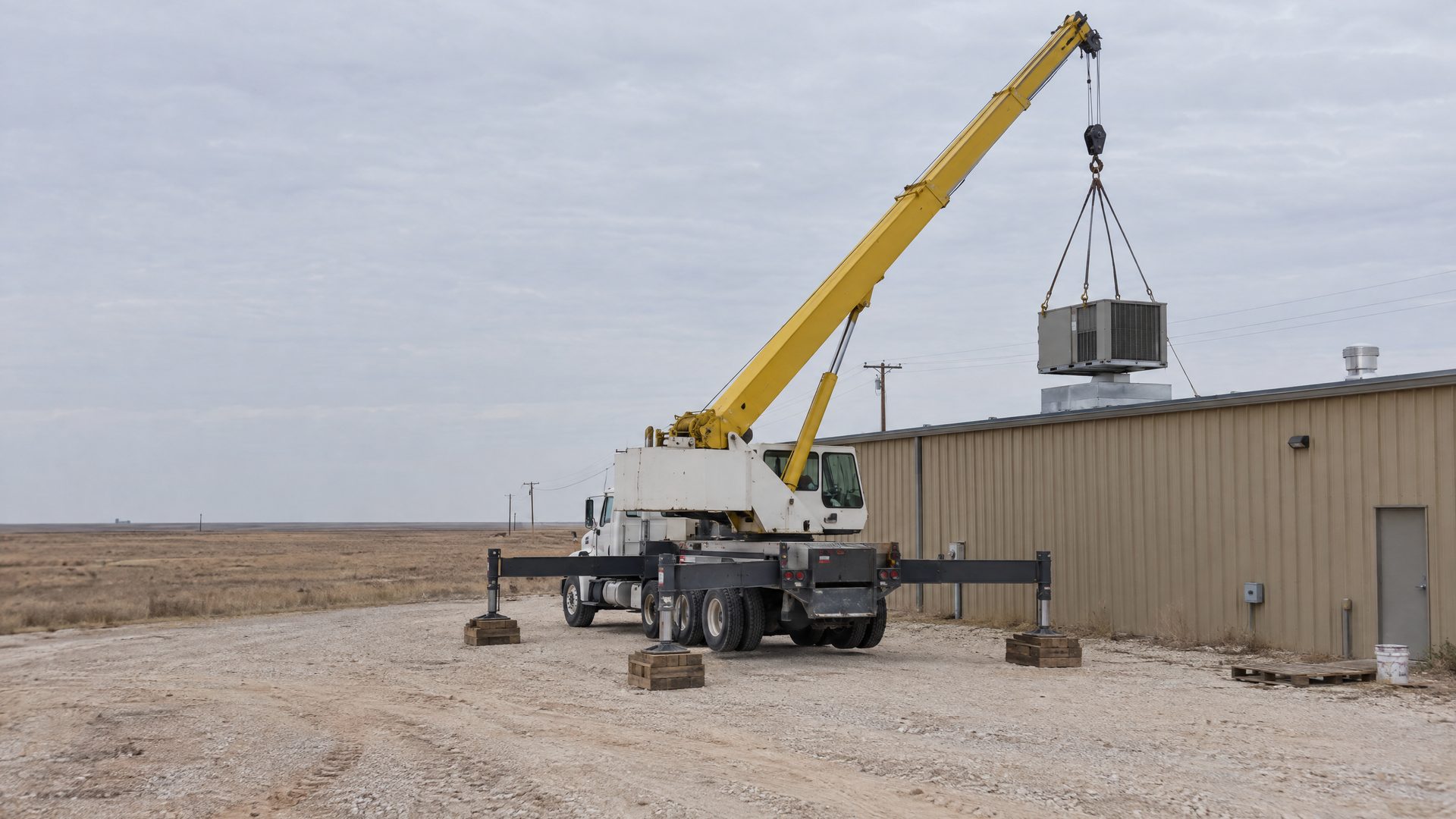
Crane Rental in Tulia, TX
Crane rental in Tulia comes down Interstate 27. The Handbook of Texas entry for Tulia places the Swisher County seat on "U.S. Highway 87 forty-nine miles south of Amarillo in the central part of the county," a route that is now also Interstate 27. The Handbook's population table gives the town 4,473 in 2020 and says it "has remained a center for farming and agribusiness activities." We bring cranes to Tulia with an operator or bare, and rent excavators, loaders, telehandlers, lifts, forklifts and dozers there by the day, week or month. The sections below go machine by machine: what each one does in Tulia and what that job hangs on.
Tulia's official websites gave us little to cite. The City of Tulia's economic development and code enforcement pages loaded without body text when we checked, and the Tulia EDC site turned our research tools away, so this page states no Tulia permit rule and no airport data. Where the record stops, the page says what a Tulia job depends on instead: Swisher County, the interstate, farm and feedlot ground, the weather, and the federal and Texas rules that follow a crane anywhere in the state. City Hall's address is on the City of Tulia's website, and county notices are posted on Swisher County's website.
a free written quote before any lift or delivery is booked.
Free quote
Rail, Farms, Feedlots and Ground: Tulia's Facts for a Job
Tulia's growth came by rail. The Handbook says "A booming new era began with the extension of the Santa Fe line to Tulia in December 1906," the same year a Santa Fe branch from Amarillo reached Swisher County. The county itself was organized after a petition circulated in June 1890, with Tulia, then "a tiny settlement," chosen as its seat. The old route through the county is "now U.S. 87 or Interstate Highway 27," in the Handbook's words, and TxDOT's newsroom describes I-27 as running from Lubbock to Amarillo. For a crane or a lowboy, that makes the trip from Amarillo to Tulia an interstate trip, which changes when a permitted load may move; the heavy haul section below has the rule.
Swisher County lives on crops and cattle. The Handbook names wheat "the county's most important crop," grown in "a mix of cotton, wheat, grain sorghum, corn," and says "During the late 1950s and 1960s many feedlot operations were established" in the county; its mid-1980s picture of Tulia includes "four large cattle-feeding enterprises nearby." On farm and feedlot ground, the earthwork falls to the loaders, backhoes, excavators and dozers in the equipment section below, and the heavy sets to boom trucks and rough-terrain cranes. The Handbook's Swisher County entry carries the full county history.
Industry is harder to pin down. The Handbook's description of Tulia's plants dates from the mid-1980s, when "local industrial plants manufactured products such as clothing and farm implements"; we found no current list of Tulia plants and name none here. Swisher County's website lists a public hearing on an amended and restated tax abatement for TX Nazareth Solar, LLC, but the linked notice is a scan with no readable text, so this page gives no size, site or schedule for that project.
For ground and water, the Handbook says Swisher County "ranges in elevation from 3,000 to 3,600 feet above sea level" and that its soils "range from alluvial silts to sandy types." Mackenzie Dam was completed on Tule Creek in 1974, and the Handbook says Mackenzie Reservoir supplies municipal water to Tulia, among other towns. No long-term wind record for Tulia is in our sources; the closest we have is the National Weather Service's Amarillo station, whose 1991-2020 normals put the yearly average wind at 13.6 mph, with March and April highest. Those tables, with Amarillo's records, are on our wind and weather page for Amarillo lifts.
See Tulia, TX on Google Maps — we quote work across the area from Amarillo.
Which Crane a Tulia Job Needs, and Why
A crane for Tulia gets chosen twice, once for the lift and once for the run down I-27. Truck cranes, all-terrain cranes and boom trucks make that run under their own power; rough-terrain cranes and crawlers travel on trailers, which adds a haul and sometimes a permit. Below, each class gets its Tulia angle and one rule that bears on it there, plus a link to its full page with specifications and published national prices.
Truck Cranes for Tulia Lifts Off the Interstate
For a Tulia lift reachable from a paved lot or a firm yard, a hydraulic truck crane is the fit: it drives I-27 from Amarillo on its own carrier, sets its outriggers and works, with no trailer. Rooftop units downtown, tanks and equipment at agribusiness sites, and steel or signs along U.S. 87 all fall in its range when the weight at the radius fits the chart. On site, one OSHA line governs every pick: "The equipment must not be operated in excess of its rated capacity" (29 CFR 1926.1417(o)(1)). The drive down and back appears as its own line on the written quote. Truck crane sizes and load charts are walked through under hydraulic truck crane rental.
All-Terrain Cranes for Heavy or Long-Reach Picks Near Tulia
An all-terrain crane makes the Tulia trip when a lift weighs too much or reaches too far for a truck crane, or when the crane must set up on a feedlot alley or field road instead of pavement. The crane itself is at home on the interstate, running at highway speed; the planning goes into the counterweight trucks the larger ATs bring, each of which has to be legal or permitted on its own, and any load more than 14 feet wide needs an escort under TxDMV's rules. For a tall boom, we found no verified airport data for Tulia in official sources, so the site and the boom's height get checked against the FAA's notice rule, 14 CFR 77.9, before the lift. Class by class, the makers' published capacities are listed under all-terrain crane rental.
Rough-Terrain Cranes on Tulia-Area Fields and Feedlots
A rough-terrain crane is the answer when a Tulia job leaves the pavement for a feedlot alley, a field edge, an equipment yard or a lot still in dirt. Built for the site rather than the highway, it rides a lowboy down I-27, and that haul is priced on the quote. At the site, OSHA section 1926.1402 puts the ground on the controlling entity, which must also tell the crane user about hazards under the set-up "such as voids, tanks, utilities" when its documents show them. Swisher County's soils run from alluvial silts to sandy types, so a pad near a creek or in a low spot deserves a look after rain. Models, and OSHA's ground rule in full, are on the rough-terrain crane rental page.
Crawler Cranes for Long, Heavy Jobs in the Tulia Area
A crawler crane only suits the long, heavy end of Tulia work, since a lattice crawler comes down I-27 in several truckloads and is assembled where it will lift. Public sources we read show no large construction project in Tulia. If your project does call for a crawler, the assembly falls under OSHA sections 1926.1403 and 1926.1404, including a director who reviews the procedures "immediately prior to the commencement" of assembly, and the tracks need ground as firm and drained as any outrigger pad. Lattice and telescopic crawlers are described under crawler crane rental.
Boom Trucks for Tulia Farm Equipment and Rooftops
A boom truck covers the lighter Tulia lifts: a rooftop unit on a downtown building, trusses on a house, a sign, or a tank, panel or piece of farm machinery at an agribusiness yard. Inside Texas's legal size and weight it makes the I-27 run with no oversize permit and no escort, which keeps a short job short. Two tests decide it. The first is the weight at the radius; past the boom truck's chart, the job moves up to a truck crane. The second is overhead lines along streets and farm roads, since the Texas high-voltage law, Health and Safety Code chapter 752, bars any part of the equipment from coming within six feet of any high-voltage line before its operator has had 48 hours' notice and agreed to a safeguard. Ratings, and when a commercial license is needed, are under boom truck rental.
Carry Deck Cranes for Tulia Shops and Plant Floors
A carry deck crane works inside a building, lifting a load, driving it down an aisle and setting it, and whether a Tulia job needs one depends on the building you have. We found no current public list of Tulia plants; the Handbook's mid-1980s description mentions plants making clothing and farm implements, and the same entry calls the town a center for farming and agribusiness. In a shop or equipment building, a carry deck can take a machine off its base, across the floor and onto its new pad. Measure the doorway, the narrowest aisle, the floor surface and the clear height overhead, and send those with the load's weight. The crane's three ratings, and where each applies, are explained under carry deck crane rental.
Lift Planning and Rigging for Tulia Jobs
A Tulia lift plan does its work in Amarillo, so the crane that covers the forty-nine miles is the right one for the weight, the radius and the site. We ask for the load's weight from its maker or a recognized calculation, the rigging, the pick and set points, the ground and any overhead line, and check them against the load chart. Two items are particular to Tulia. A pick beside I-27 or another public road can create a point of hazard, where OSHA's 29 CFR 1926.200(g) calls for warning signs and devices laid out to Part 6 of the MUTCD. And the wind forecast leans on regional data, since our long-term records are Amarillo's. Throughout, 29 CFR 1926.1418 gives the operator authority to stop and refuse loads "Whenever there is a concern as to safety." Signals and signal persons are covered under rigging and lift planning.
Heavy Haul to Tulia on Interstate 27
Heavy haul to Tulia rides the interstate, and that matters for the clock. 43 TAC section 219.11 lets a TxDMV-permitted load run outside daytime when it is "traveling on an interstate highway and does not exceed 10 feet wide" and 100 feet long, "with front and rear overhang that complies with legal standards." Bigger loads keep to daytime, which the Transportation Code defines as "the period beginning one-half hour before sunrise and ending one-half hour after sunset," unless TxDOT studies the route and traffic and an exception is granted. The interstate exception reads only on the interstate; the county road or feedlot lane at the end of the run is not one. TxDMV's page on the annual crane permit also puts routing on the mover: "You are responsible for routing and obtaining current restrictions prior to movement." Machinery moves and permit fees are explained under heavy haul and machinery moving.
Equipment Rental for Tulia Farms, Feedlots and Builders
Rental equipment reaches Tulia on a trailer down I-27, and the written quote names the machine, the rental period by the day, week or month, the delivery charge and any tax line before anything is loaded. Anyone running a rented forklift, telehandler or aerial lift needs training under OSHA's rules and the ANSI/SAIA standards, and we ask about that training when you book. The eight classes below run from digging to grading, each with what decides it on Swisher County ground and a link to its full page.
Excavators for Tulia Trenches and Footings
An excavator digs Tulia's trenches, footings and line work, a mini excavator inside town lots and a full-size machine on open farm ground. The notice clock comes from state law: under Utilities Code section 251.151 the call goes in "not earlier than the 14th day" before the dig and no "later than the 48th hour" before it, "excluding Saturdays, Sundays, and legal holidays." In the trench, Swisher County's alluvial silts and sandy soils are not the stable rock OSHA's exception describes, so a cut of 5 feet or more needs a protective system under 29 CFR 1926.652, and spoil and equipment stay 2 feet or more from the trench edge unless a retaining device holds them back, under 29 CFR 1926.651(j)(2). Machine sizes and national day rates are set out under excavator rental.
Skid Steers and Track Loaders Around Tulia
A skid steer or compact track loader is the small loader for Tulia's farms, feedlots and building lots, on tires or on tracks depending on how firm the ground is. When the loader carries pallet forks to move bagged seed or feed rather than dirt, check which OSHA rule applies: OSHA's October 21, 1999 letter says its forklift standard "does not apply to earthmoving equipment even if it has a fork lift attachment," and adds, "However, if it is not earthmoving equipment, it is covered," which brings forklift-style operator training and evaluation with it. Rated operating capacities, and the tires-or-tracks choice, are compared under skid steer and track loader rental.
Telehandlers for Tulia Ag Buildings and Job Sites
A telehandler sets pallets, roofing and framing up on a Tulia barn, shop or job-site deck. OSHA's eTool does not use the word telehandler, but its Class VII rough terrain forklifts include a "Variable reach type" with a telescoping boom, which matches this machine. OSHA's June 21, 2012 letter puts dual-purpose machines, ones designed for crane and forklift work alike, under the crane standard "when configured, and operated as, a crane," and says the forklift-and-boom setup it reviewed "is not covered by the cranes standard." Capacity shrinks as the boom extends, so place the machine on firm ground as close to the set as the job allows. Lift heights and capacity at full reach, by model, are on our telehandler rental page.
Boom Lifts for Tulia Storefronts, Signs and Shops
In Tulia, a boom lift is the way up to a storefront sign, a light pole, a tank or the side of a shop, with articulating booms for reaching over things and telescopic booms for long straight reach. Under OSHA section 1926.453, "Only authorized persons shall operate an aerial lift," "Lift controls shall be tested each day prior to use," and the brakes are set with any outriggers on pads or a solid surface. Wind is the Tulia variable. The closest long-term normals in our sources are Amarillo's, where March averages 15.5 mph, and the machine's maker sets the wind limit the operator works to. Heights, outreach and the ANSI/SAIA training standards are covered under boom lift rental.
Scissor Lifts for Indoor and Yard Work in Tulia
A scissor lift takes a crew straight up to a ceiling, wall or storage rack inside a Tulia shop, store or warehouse, and a rough-terrain model does the same on a gravel or dirt yard. Outdoors, the weather sets the limit: "Scissor lifts rated for outdoor use are generally limited to wind speeds below 28 miles per hour," in the words of OSHA's scaffolding eTool, and a separate OSHA hazard alert adds: "Use the scissor lift outside only when weather conditions are good." The same eTool says to pick work spots at least 10 feet from power lines and transformers, and that "Only trained workers are allowed to use scissor lifts." Platform heights, slab against rough-terrain, are compared under scissor lift rental.
Forklifts for Tulia Agribusiness Warehouses and Yards
A forklift moves pallets, bagged product and parts through Tulia's agribusiness warehouses and yards, on cushion tires indoors and pneumatic tires outside. OSHA's training rule asks for a record: the employer must certify each operator's training and evaluation, with the operator's name, the dates of both, and "the identity of the person(s) performing the training or evaluation." Under 29 CFR 1910.178(l)(4), refresher training is due when an operator "has been involved in an accident or near-miss incident" or "is assigned to drive a different type of truck," among other triggers. Renters' operators should meet that rule before the machine runs. Capacities and published rates are under forklift rental.
Backhoes and Loaders for Tulia Lines and Lots
A backhoe loader opens a service trench or a short water line in Tulia and backfills it with the same machine, while a wheel loader shifts gravel, soil or feed by the bucketful across a yard or feedlot. Texas811's FAQ answers a plain "Yes." to the caller who is not digging very deep and wonders whether to call. Once lines are marked, Texas811's FAQ says APWA and industry practices "set 18 inches on either side of the marked utility as a reasonable tolerance zone," and an excavator must renotify "if the commencement is delayed beyond fourteen days of the original notice." Dig depths and loader bucket sizes appear under backhoe and loader rental.
Dozers for Clearing and Grading Near Tulia
A dozer clears brush, strips topsoil and grades pads, pens and farm roads around Tulia, matched in size to the area and how deep the cut goes. Two items belong in the plan. If cleared brush is to be burned, check the county's current notices first; its website posted a burn ban effective from July into October 2026. And where buried lines may run, the 811 call comes before the blade. On the machine itself, OSHA's backup-alarm rule, 29 CFR 1926.602(a)(9)(ii), forbids reversing earthmoving equipment "which has an obstructed view to the rear" unless a reverse alarm works or "an employee signals that it is safe to do so." Blade capacities and operating weights by class are under dozer rental.
Permits, Power Lines, 811 and Roads for Tulia Lifts
For a crane or machine in a Tulia street, sidewalk or alley, the City is the first stop: no City of Tulia permit rule was readable online when we checked, and City Hall is at 127 SW 2nd Street, as the City prints it. County roads are a Swisher County question, and the courthouse is at 119 S Maxwell Ave. On I-27 and other state highways the agency is TxDOT, but Swisher County is not among the counties listed in TxDOT's Amarillo District profile, so confirm which TxDOT district office handles the road before a lift or a lane closure is planned.
Overhead lines follow state and federal law in Tulia as anywhere in Texas. Texas Health and Safety Code section 752.003 requires the party responsible for work closer than six feet to a high-voltage line to notify the line's operator at least 48 hours ahead and to wait for an agreed safeguard, such as de-energizing, moving or guarding the line; under section 752.003(c), that party pays the operator's actual expense of providing the clearance. OSHA's crane rule adds its own 20-foot screening test under section 1926.1408. Both rules, with Texas 811 and FAA notice, are laid out in our guide to crane permits, power lines and airspace.
Airspace rules apply in Tulia even without a verified runway figure. Under 14 CFR 77.9(a), the FAA must get notice of anything more than 200 feet tall at its site, wherever it stands, and the runway slopes in paragraph (b) add notice for lower objects near the airports the rule covers. Before a tall boom goes up, the site gets checked against that rule, and if notice is due, the Form 7460-1 has to reach the FAA no less than 45 days before the work.
- Tulia City Hall, 127 SW 2nd Street: ask there before a crane, lowboy or machine works in a city street.
- Swisher County posts public notices, such as its 2026 burn ban, on the county website.
- Texas811's FAQ says utilities "have 48 hours to locate, but this does not include holidays."
- TxDMV's restricted holidays include Thanksgiving Day and Christmas Day 2026 and New Year's Day 2027; on those days a load over 16 feet high, 14 feet wide or 110 feet long stays parked unless TxDMV grants an exception.
- Every operated crane falls under OSHA section 1926.1427, which requires an operator who "is trained, certified/licensed, and evaluated"; on a bare rental, your operator has to meet it.
Tulia FAQs
Do you bring cranes to Tulia, or only work in Amarillo?
We bring them to Tulia. A truck crane, all-terrain crane or boom truck makes the drive under its own power; an RT, a crawler or a rented machine rides a trailer. Jobs in Canyon, which also sits on Interstate 27, are on our Canyon page. For a price, tell us the weight of the load, where it starts and where it lands, how firm the ground is, where power lines run, and the street address and work dates. Our written quote, free of charge, spells out which crane or machine, who runs it, how many hours or days are booked, and what the travel or delivery costs.
What will a crane job in Tulia cost?
The total is the lift plus the trip: the size and type of crane, whether an operator comes with it, how many hours or days it is booked, and the drive down I-27. Published national ranges for most classes, with source and date, are gathered under the price ranges for cranes and equipment. For tax, the Comptroller's Rule 3.294 says one charge for equipment with its operator "shall be presumed to be the performance of a service and no tax may be charged" unless the work is taxable, while a lease without an operator is taxable. The written quote shows each charge and any tax line.
Do I have to call 811 before digging on a farm near Tulia?
Texas Utilities Code section 251.156(a)(4) exempts "activities performed on private property in connection with agricultural operations," and whether a given farm dig falls within that exemption is a legal question for the owner. The exemption does not move a pipeline or a buried cable, and on construction work OSHA requires the estimated location of underground utilities to be determined before an excavation opens. So before a rented machine digs, the 811 call is made first, by us or by you, two business days ahead.
How windy is too windy for a crane job in Tulia?
The crane's manufacturer and load chart set the wind limit, and OSHA has the competent person adjust the work "to address the effect of wind, ice, and snow on equipment stability and rated capacity." No long wind record for Tulia is in our sources; Amarillo's National Weather Service normals average 13.6 mph over a year, highest in March at 15.5 mph. We watch the forecast before the trip; a lift is called off when the competent person or operator judges conditions unsafe, and a wind delay is rescheduled, with standby billed as the quote states.
Get Your Free Tulia Quote
Free quote