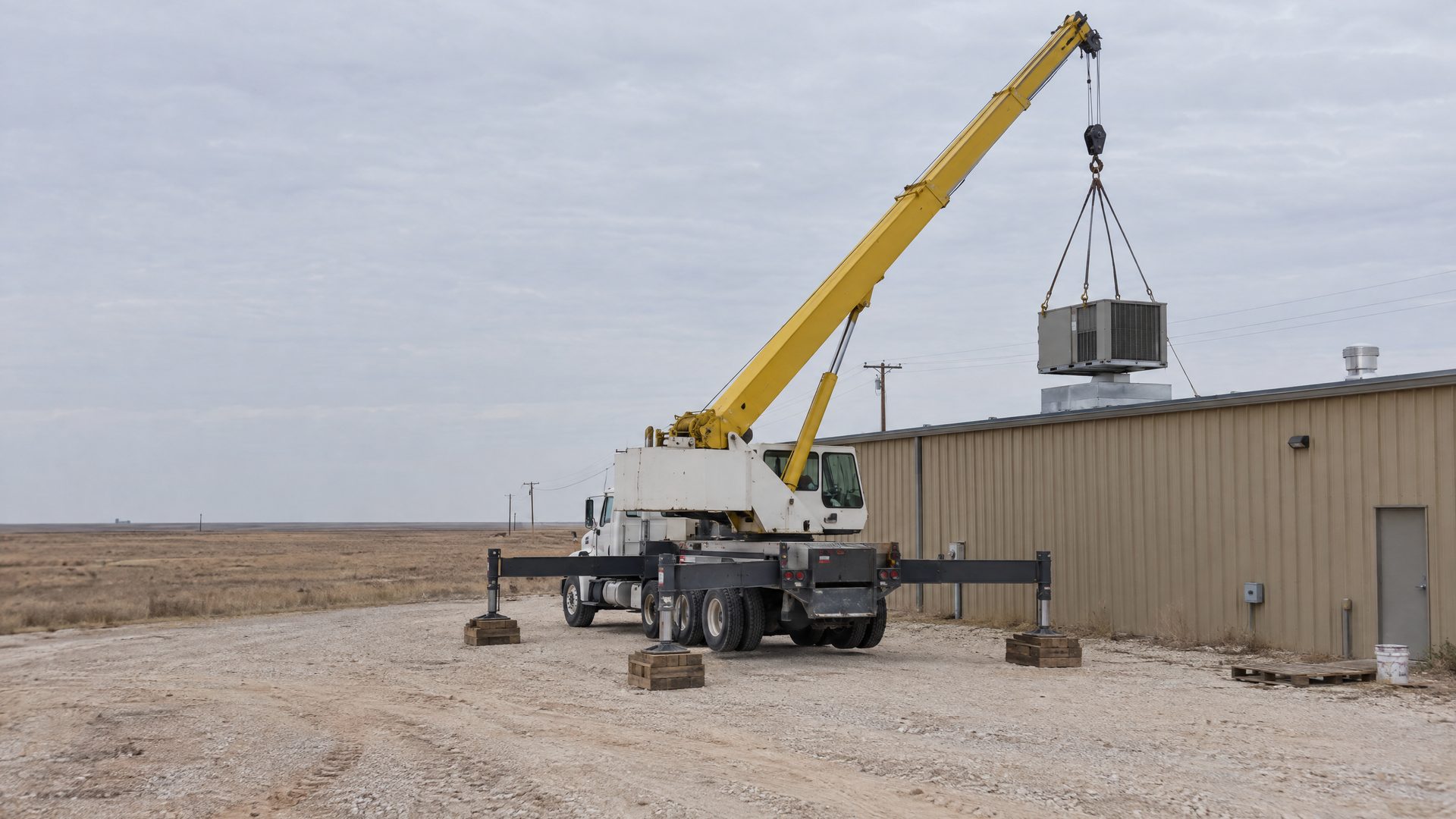
Crane Rental in Dalhart, TX
Crane rental in Dalhart starts with the trip: the crane or machine comes from Amarillo to a town where three U.S. highways meet, and what it does on arrival follows the town's own work; the Handbook of Texas entry for Dalhart lists "cattle feedlots, a bottling plant, and feed and meat processing plants." Dalhart is the county seat of Dallam County and straddles the Dallam-Hartley county line, with a 2020 Census population of 8,447 and a Census estimate of 8,377 for July 1, 2025. We bring cranes there with an operator or bare, and excavators, loaders, lifts, forklifts and dozers by the day, week or month. Each section below takes one machine and says what it does in Dalhart, what that job depends on and which rules apply.
Dalhart's public record is thinner than Amarillo's, and this page says so where it matters. The City of Dalhart's website and the Dalhart EDC's site were closed to our research tools when we checked, so we cite no City permit rule, no runway figure for the municipal airport and no official road mileage from Amarillo. Where a fact is missing, we name what the job turns on instead: the county, the highway, the ground, the wind, and the state and federal rules that hold in every Texas town.
a free written quote before any lift or delivery is booked.
Free quote
Rail, Highways, Plants and Ground: What Dalhart Means for a Lift
Dalhart began at a rail crossing. The Handbook of Texas says the settlement was "platted early in 1901" when the Chicago, Rock Island and Pacific Railway built west from Liberal, Kansas, and crossed the Fort Worth and Denver City line, and its Dallam County entry, revised in 2020, adds that "The two railroads in the town contribute to the local economy." Highways meet there too: U.S. 87, 385 and 54 converge in Dalhart, and U.S. 54 carries on to Liberal and to Tucumcari, New Mexico. For a crane, a lowboy or a trailer of equipment, the point is that the highways meeting at Dalhart are U.S. highways, not interstates, and that sets the hours a permitted load may travel, as the heavy haul section below explains.
Dalhart's named plants handle food, feed and bottling. Hilmar Cheese Company's timeline lists 2007 for its "New Dalhart, TX manufacturing site," opened as a plant "producing cheese and whey protein products," according to Hilmar's own heritage page. The Handbook adds a bottling plant and feed and meat processing plants. Inside buildings like these, the lifting falls to carry deck cranes, forklifts and scissor lifts; on a roof or a tank pad reached from a paved lot, it falls to a truck crane or a boom truck. We name these plants to describe what the town makes, not as customers or as places we have worked.
Cattle and grain run the county around the town. The Handbook says Dallam County farms "produce large numbers of beef cattle" and grow "wheat, corn, milo, sorghum, and other grain products," and it lists cattle feedlots at Dalhart itself. Ranching came first: Dalhart grew as "a shipping center for the XIT Ranch and other area ranches." The town keeps that past in the XIT Museum and the XIT Reunion, "complete with parade and rodeo," so a crane or lowboy move through town is worth checking against the reunion dates.
Ground and weather complete the picture. The Handbook describes Dallam County's "sandy, sandy loam, loam, and salty clay loam soils," crossed by "the intermittent Rita Blanca, Carrizo, and Coldwater creeks," and the Texas Almanac table on the same page gives the county's altitude as 3,655 to 4,780 feet. Wind is what moves dates: in the National Weather Service's March 2025 dust and wind summary, the Amarillo office wrote that on March 3 "The highest wind gust measured was 69 mph around Dalhart, TX." No long wind record for Dalhart is in our sources, so a lift plan starts from the Amarillo normals and records on our Amarillo wind and weather data page and from the forecast for the day.
See Dalhart, TX on Google Maps — we quote work across the area from Amarillo.
Cranes for Dalhart: Which Class Fits the Lift
Every crane that works in Dalhart travels there first, so the choice starts with how it moves and what the site can carry. Truck cranes, all-terrain cranes and boom trucks drive in on their own wheels; rough-terrain and crawler cranes ride trailers and add a haul to the job. Each class below gets its Dalhart angle: the jobs it fits in town, what the work there depends on and a rule that applies, with a link to the full page for its specifications and national prices.
Mobile Truck Cranes for Lifts Around Dalhart
A hydraulic truck crane fits a Dalhart lift when it can park on pavement or firm, level ground within reach of the load, because it drives the whole way from Amarillo on its own carrier, with no trailer. That covers rooftop units, tanks and equipment set from a plant's paved lot. A crane over Texas's legal width or weight can make the drive under the yearly TxDMV permit for unladen lift equipment, a $100 permit capped at 10 feet wide and 120,000 pounds gross, and the written quote shows the travel as its own charge. Wind can stop the day even when the weight fits, since OSHA section 1926.1417(n) tells the competent person to adjust the work for wind. Load charts and truck crane sizes are explained on our mobile crane rental page.
All-Terrain Cranes for Heavier Picks in Dalhart
An all-terrain crane earns the trip to Dalhart when the pick outweighs or outreaches what a truck crane can handle, or when the set-up spot is a feedlot road or plant yard off the pavement, since an AT travels at road speed yet copes with rough site tracks. The planning goes into the convoy: larger ATs carry part of their counterweight on separate trucks, and each truck must be within Texas's legal size and weight or travel on its own TxDMV permit. A long boom also raises the airport question in the rules section below, because the FAA's notice slopes depend on a runway length we could not confirm for Dalhart. All-terrain crane rental lists the classes and the makers' published capacities.
Rough-Terrain Cranes on Dalhart Farm and Feedlot Ground
A rough-terrain crane is the crane for a Dalhart-area site with no paved access, such as a feedlot alley, a grain site or a ranch yard, because it drives and lifts from one cab and is built for unimproved ground. It is a site machine rather than a highway one, so it comes from Amarillo on a trailer and the haul is part of the quote. Ground decides the rest. Dallam County's soils run from sand to salty clay loam in the Handbook's description, and OSHA section 1926.1402 lets a crane work only on ground that is "firm, drained, and graded" well enough, with blocking or mats as needed, for the maker's support and leveling specifications. The controlling entity on the site must see that it is prepared. Our rough-terrain crane rental page covers the models and OSHA's ground rule in full.
Crawler Cranes and Long Projects Near Dalhart
A crawler crane fits a Dalhart job only when the work is long and heavy enough to repay its transport, several truckloads for a lattice crawler, and an assembly on site. We found no large construction project in Dalhart in the public sources we read, so a crawler there is a case-by-case call built on your lift list. If it goes ahead, OSHA sections 1926.1403 and 1926.1404 govern the assembly, and the assembly director must weigh site and ground conditions and "The effect of wind speed and weather on the equipment," a live question given the 69 mph gust the weather service reported around Dalhart in March 2025. Each transport load is its own TxDMV size and weight check. The lattice and telescopic classes are set out under crawler crane rental.
Boom Trucks for Dalhart Rooftop, Sign and Farm Sets
A boom truck is the light crane for Dalhart: a hydraulic boom on a commercial truck that drives from Amarillo and sets rooftop units, signs, trusses, steel and farm equipment without a second vehicle. Around the feedlots and grain farms the Handbook describes, it can place tanks, panels and machinery when the weight at the radius fits its chart, and it leaves once the pick is done. Within Texas's legal size and weight it needs no oversize permit for the drive. Three checks decide whether one is enough: how much the load weighs at the reach you need, a level spot for its outriggers, and any power line near the boom's swing. See boom truck rental for truck ratings and the license question.
Carry Deck Cranes Inside Dalhart's Food and Feed Plants
A carry deck crane is the crane for lifts inside a Dalhart plant, because it can raise a load, travel with it hanging from the hook or resting on its own deck, and set it down in a spot no truck crane can reach. The plants the public sources name in town are Hilmar's cheese and whey protein plant, a bottling plant, and the feed and meat processing plants in the Handbook. In buildings like these the deciding numbers are the door width, the aisle, the floor and the overhead clearance, so we ask for them along with the weight. The machine's three separate ratings are compared on the carry deck crane page.
Rigging and Lift Plans for Dalhart Lifts
A lift plan for Dalhart gets written before the crane leaves Amarillo, because a wrong weight, radius or set-up spot found on site means a wasted trip. The plan lists what the load and its rigging weigh, the crane's set-up spot and working radius, the ground beneath the outriggers, the person giving signals and the barricade line. Under 29 CFR 1926.1417(o)(3)(i), the first of OSHA's two methods, the weight "must be determined from a source recognized by the industry (such as the load's manufacturer)," or by a recognized calculation, and the operator may ask for it before the lift. Where a pick beside one of the U.S. highways through town counts as a point of hazard, 29 CFR 1926.200(g) also requires signs and traffic control devices that conform to Part 6 of the MUTCD. Signals, signal persons and critical lifts get their own treatment under rigging and lift planning.
Heavy Haul to Dalhart on U.S. 87, 385 and 54
Heavy haul to Dalhart arrives where three U.S. highways meet, and that sets the clock. Under 43 TAC section 219.11, TxDMV's movement rule, permitted loads travel by day; its exceptions cover a load that is overweight only, one on an interstate within set dimensions, and night movement granted on a TxDOT route and traffic study. None of the three highways that meet at Dalhart is an interstate. The Transportation Code counts daytime from half an hour before sunrise to half an hour after sunset. If the route uses U.S. 87 west of Dumas, TxDOT's project page describes the stretch from east of the US 385 interchange to FM 2589 as a two-lane facility it would upgrade to four-lane divided, with no construction funding identified. On a two-lane highway, a load wider than 14 feet but no wider than 16 takes its single escort in front instead of behind. Permit types, fees and moves inside a plant are on our heavy haul page.
Heavy Equipment Rental in Dalhart by the Day, Week or Month
Equipment for Dalhart rides a trailer from Amarillo, so every rental there starts with delivery, and the written quote shows the delivery charge, the rental period and any tax line before the machine is loaded. On tax, the Comptroller's Rule 3.294 is plain: "Receipts from the lease of tangible personal property without an operator are taxable." The eight classes below cover digging, loading, lifting people, lifting material and grading, each with what decides it in Dalhart and a link to its full page.
Excavators and Mini Excavators for Dalhart Digs
An excavator digs Dalhart's trenches, footings and utility lines: a mini excavator for a town lot or the inside of a plant fence, a full-size machine for a long run across farm or feedlot ground. Two rules come before the bucket. Texas 811 says "Texas law requires excavators to contact 811 at least two business days before excavating," and OSHA's trench rule, 29 CFR 1926.652, calls for a protective system, such as sloping, shoring or a shield, once a trench reaches 5 feet, unless it is cut in stable rock. Sand and loam, the soils the Handbook lists for Dallam County, are not stable rock, and OSHA wants a competent person to inspect the trench daily and "after every rainstorm." Mini and full-size models and national rates are compared on our excavator rental page.
Skid Steers and Track Loaders for Dalhart Yards
A skid steer or compact track loader handles the small loader work at Dalhart's feedlots, plant yards and building lots: moving material, grading a pad, cleaning up after a job. The ground picks between tires and tracks. On firm yards and pavement a wheeled skid steer does the work; on loose sand or soft, wet loam, the soils the Handbook names for Dallam County, a track loader spreads its weight across its tracks. On construction work, OSHA's rollover subpart (section 1926.1000) covers rubber-tired skid steers built after July 15, 2019. Tires against tracks, with rated capacities, is the subject of our skid steer and track loader page.
Telehandlers for Dalhart Farm Buildings and Job Sites
A telehandler is the machine for lifting pallets, roofing, framing and steel up and out onto a Dalhart building or farm structure: a forklift-style carrier with a telescoping boom. JLG markets its fork-mounted truss boom for "metal building erection, setting wooden trusses and erecting post frame buildings." Capacity drops as the boom reaches out, so the set is planned from where the machine can stand on firm ground. The operator needs the training and evaluation OSHA sets in 29 CFR 1910.178(l), with a performance evaluation "at least once every three years," and we ask that a renter's operators have it. Reach and capacity figures for example models are under telehandler rental.
Boom Lifts for Work at Height in Dalhart
A boom lift raises a worker beside a Dalhart storefront, sign, light, tank or plant wall, with an articulating boom to reach up and over and a telescopic boom for straight reach. The job depends less on the town than on the work: the height, the reach over obstacles, the ground and the wind. OSHA's aerial-lift fact sheet tells operators not to work "in high winds above those recommended by the manufacturer" and says to keep at least 10 feet from overhead lines, and Texas law separately keeps equipment six feet clear of a high-voltage line unless the line's operator has had notice and a safeguard is in place. Articulating and telescopic heights, outreach and ANSI/SAIA training are on the boom lift rental page.
Scissor Lifts for Dalhart Plant and Shop Interiors
A scissor lift is the platform for overhead work inside Dalhart's plants, shops and warehouses: lights, ductwork, piping and ceilings reached straight up from a slab, with rough-terrain models for gravel or dirt yards. OSHA does not treat a scissor lift as an aerial lift. Its August 1, 2000 letter says scissor lifts "do meet the definition of a scaffold," which brings in OSHA's mobile scaffold requirements, and with properly maintained guardrails neither scaffold section requires workers to be tied off. OSHA's scaffolding eTool adds that "Scissor lifts must have guardrails installed to prevent workers from falling." Slab and rough-terrain models, by platform height, are under scissor lift rental.
Forklifts for Dalhart Warehouses and Feed Plants
A forklift moves pallets, bags and parts through Dalhart's warehouses, feed plants and loading areas; cushion tires suit a smooth plant floor and pneumatic tires a yard. For gravel or unimproved lots, OSHA's eTool puts rough terrain forklifts in Class VII and warns that "the term 'rough terrain' does not imply that the forklift can be safely operated on every conceivable type of terrain." Every operator needs training and an evaluation under 29 CFR 1910.178(l) before driving one, and we ask that a renter's operators have both. For capacities, mast heights and national rates, see forklift rental.
Backhoes and Wheel Loaders for Dalhart Farm Work
A backhoe loader digs and backfills a farm water line or a service trench around Dalhart with one machine, and a wheel loader has no backhoe and carries feed, gravel or soil in a bigger bucket. Farm digs raise a Texas law question: Utilities Code section 251.156(a)(4) exempts "activities performed on private property in connection with agricultural operations." Whether a given dig qualifies is the owner's question to settle, and a buried pipeline or cable is there either way, so before any digging we or you call Texas 811. Dig depths, bucket sizes and trench rules are covered under backhoe and loader rental.
Dozers for Clearing and Grading Around Dalhart
A dozer clears, strips and grades ground around Dalhart for a pad, a pen, a road or a building site, sized to the acreage and the depth of cut. Texas counts that blade work as excavation once it disturbs soil "to a depth of 16 or more inches" (Utilities Code section 251.002), so the 811 call comes first wherever buried lines may run. The county's history is a reason to think about timing: the Handbook says "The Great Depression and Dust Bowl dealt harshly with Dallam County's economy," and ground graded bare in a windy month stays open to the wind until it is built on or covered. Blade sizes and ground pressure by class are on our dozer rental page.
Permits, Roads, Power Lines and Airspace for Dalhart Lifts
No City of Dalhart permit rule for cranes or street work appears here, because the City's website was closed to our research tools when we checked; before a crane or machine sets up on a Dalhart street, sidewalk or alley, ask the City what it requires. The City of Amarillo's right-of-way permit covers Amarillo's own streets and does not reach Dalhart. TxDOT's Amarillo District profile lists Dallam and Hartley among the counties it covers. OSHA's 29 CFR 1926.200(g) requires traffic control devices that meet Part 6 of the MUTCD wherever a construction area beside traffic is a point of hazard.
Overhead lines are covered by federal and state law, so the rules hold in Dalhart unchanged. OSHA section 1926.1408 has the employer determine whether any part of the equipment, load line or load, rigging included, "could get closer than 20 feet to a power line," and if so pick one of three options: have the line deenergized and grounded, keep 20 feet away, or keep the Table A distance for the line's voltage. Texas Health and Safety Code chapter 752 adds a six-foot rule with notice to the line's operator at least 48 hours ahead. Underground lines come under Texas 811 and Utilities Code chapter 251. Each rule is set out in full in our guide to street permits, overhead lines and FAA notice.
Airspace is the open question. The Handbook's Dalhart Army Air Field entry says several buildings of the old base, a "3,000-acre field" two miles southwest of town that was activated in September 1942 and closed early in 1946, "have been used as the Dalhart municipal airport." Under the FAA's notice rule, 14 CFR 77.9, anything rising more than 200 feet above its own site needs notice, and near an airport a sloping surface from the nearest runway catches lower objects: 100 to 1 out to 20,000 feet when the longest runway is more than 3,200 feet long, 50 to 1 out to 10,000 feet when it is not. We could not confirm the Dalhart runway's length from an official source, so before a tall boom goes up in Dalhart we run the site through the rule and say whether the FAA needs a Form 7460-1, which is due at least 45 days before the work.
- Texas 811: the locate request goes in two business days before digging, and Texas811 says holidays "are not included in the two working day waiting period required prior to excavation."
- TxDMV's no-permit limits: 80,000 pounds gross weight, 14 feet of height and a width of 8 feet 6 inches.
- TxDMV's holiday rule: no movement on its listed holidays, Thanksgiving and Christmas among them, for a load more than 110 feet long, 16 feet high or 14 feet wide, unless TxDMV grants an exception.
- Operated cranes: under OSHA section 1926.1427, an operator has to be trained, evaluated and certified or licensed; a bare rental needs your own operator to meet it.
Dalhart FAQs
Do you bring cranes and equipment to Dalhart from Amarillo?
Yes. Truck cranes, all-terrain cranes and boom trucks drive to Dalhart on their own; rough-terrain cranes, crawlers and rental equipment go on trailers. The Handbook of Texas puts U.S. 87 at Amarillo, Dumas and Dalhart, so the run likely passes through Dumas, whose own jobs are on our Dumas page. The written quote lists the travel or delivery charge with any TxDMV permit or escort the move needs. Tell us what the load weighs, where it is picked up and set down, what the ground and access are like, where any overhead lines run, and the site address and dates; the written quote, which is free, comes back before work starts.
How much is a crane rental in Dalhart?
The bill comes from four things: which crane class and size, whether it comes with an operator, the minimum hours or the rental period, and the travel from Amarillo. Published national ranges for most classes sit on our price page for cranes and equipment, with the source and date beside each figure. Public fees sit on top where a move needs them, such as TxDMV's $100 annual permit for a crane over legal width or weight. A Dalhart job gets a free written quote with each charge shown.
Who has to get the ground ready for a crane on a Dalhart feedlot or farm?
The controlling entity on the site, under OSHA section 1926.1402. It must see that the ground is prepared so the crane's support and level requirements are met, and pass any hazard its documents show beneath the set-up area, "such as voids, tanks, utilities," on to the crane's user and operator. When the operator judges the ground inadequate, OSHA has that operator's employer talk the needed preparation through with the controlling entity. On sand or freshly worked ground, ask for mats or cribbing to be priced in the quote.
Do I need FAA approval for a crane near the Dalhart airport?
You may need to file notice, depending on the boom's height and its distance from the runway. The FAA rule, 14 CFR 77.9, covers any object over 200 feet tall wherever it stands, plus shorter ones that would break the imaginary slope rising from the nearest runway, and how far that slope reaches depends on the runway's length. We could not confirm the Dalhart runway length from an official source, so we check your site and height against the rule. If notice is due, the Form 7460-1 must be filed a minimum of 45 days before work starts, and the FAA replies with a determination.
Get Your Free Dalhart Quote
Free quote