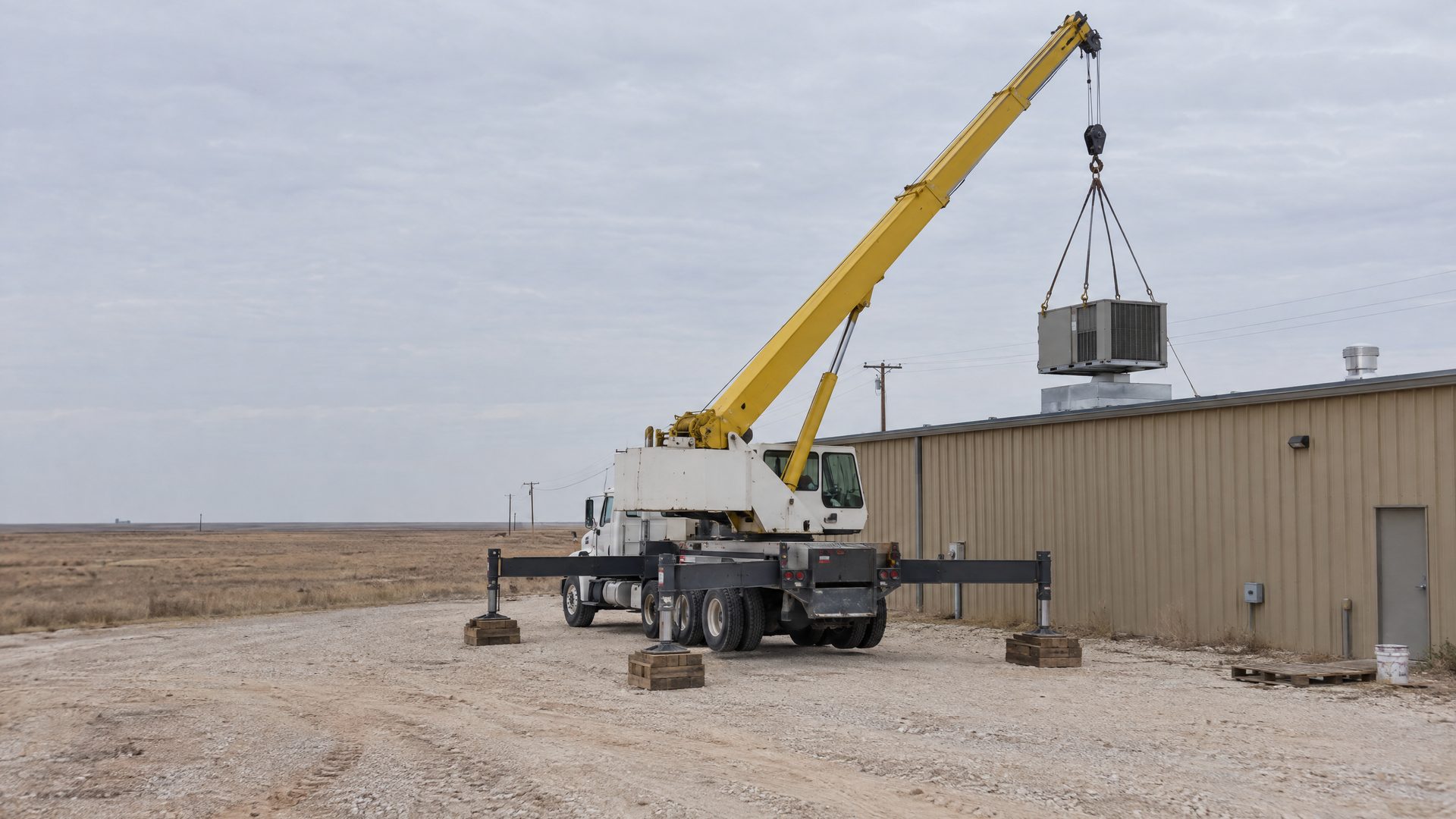
Crane Rental in Panhandle, TX
Crane rental in Panhandle means a crane or machine sent from Amarillo out US 60 to the county seat of Carson County, a town the Handbook of Texas places "in the south central part of the county." The Handbook's population table lists 2,378 for 2020, a small town inside a county that holds two very large sites: the Pantex Plant, which its official site puts in "Carson County near Amarillo, Texas," and Project Matador, which Fermi America says, on a home page last modified October 13, 2026, will sit on about 8,400 acres next to Pantex. Oil and gas leases, Pattern Energy's 400 MW wind farm and the wheat and cattle trade fill in the rest of the county's work.
We found no official mileage from Amarillo to Panhandle, so the written quote prices the actual run to your gate; the quote costs nothing and comes before any work. What decides a lift out here is the county's clay ground, the wind across open prairie, overhead lines, the distance to the runways at Rick Husband Amarillo International Airport and the rules of whoever controls the site. The City of Panhandle's website could not be read when our facts were gathered, so this page states no city permit rule. Tell us the load's weight and size, the pick and set points, the ground, any lines nearby, the location and your dates, and we answer in writing.
a free written quote before any lift or delivery is booked.
Free quote
Carson County Around Panhandle: Pantex, Matador, Wind and Wheat
Panhandle grew up with the railroad and the oil boom. The Handbook of Texas says the town "was platted in January 1888 as the terminus of the Southern Kansas" Railway, that it became county seat as "the county's only town at that time," and that in 1926 the Panhandle and Santa Fe built "a thirty-two-mile spur from Panhandle to Borger." The oil boom of the 1920s took the population to 2,035 by 1930, and the Handbook's 1995 entry calls Panhandle "a regional marketing and shipping center for wheat, cattle, and petroleum products." Carson County, it adds, "has remained a substantial, if not spectacular, producer of oil and gas."
The Pantex Plant lies in Carson County, and its official About page gives the scale: "Operations at Pantex are primarily conducted on 2,000 acres of the 18,000-acre site," with "more than 4,600 full-time personnel," and "PanTeXas Deterrence, LLC (PXD) is the management and operating contractor." From 1975 on, that page says, Pantex has been the nation's primary assembly and disassembly site for nuclear weapons. Its history page dates first operations to September 17, 1942, "only nine months after the commencement of construction," when the wartime ordnance plant made "conventional bombs and artillery shells" on 16,000 acres east of Amarillo. We name Pantex for what its own pages say it is; this page claims no work or access there.
Fermi America says its Project Matador "will be a 17GW private power and AI campus in the Texas Panhandle" (home page, published June 24, 2025, last modified October 13, 2026), on about 8,400 acres "Next to the Pantex DOE complex," with "~6 of 17GW already permitted." The same page gives two years for first power, 2026 in its text and 2027 in a statistic box, and the company's Community Questions page (September 1, 2026) says "Phase 1 of the project will run primarily on natural gas." On October 9, 2026, Fermi America reported that the U.S. Nuclear Regulatory Commission had published a draft environmental review for "four planned Westinghouse AP1000 nuclear reactors at the site," with the final review, safety evaluation and Commission decision still ahead. Fermi America's project home page carries the company's current figures.
Wind power already stands in the county. Pattern Energy's Panhandle Wind project page says "The 400 MW Panhandle Wind facility includes two phases that began operations in 2014," with 118 General Electric 1.85 MW turbines in phase 1 and 79 Siemens Gamesa 2.3 MW turbines in phase 2. Rules for jobs like these come from the county, the State of Texas and federal agencies rather than from Amarillo: the City of Amarillo's Fermi Project page says the Matador site sits outside Amarillo's city limits, beyond the City's say over land sales and development approvals.
The Handbook of Texas describes Carson County as "level to rolling prairies surfaced by dark clay and loam," between 3,200 and 3,500 feet in elevation. The USDA describes its Pantex soil series from a type site 1.1 mile northeast of Panhandle: clay at 35 to 50 percent, a shrink-swell rating (COLE) above 0.06 in the top meter, and "Deep, wide cracks greater than 51 cm (20 in) deep." Wind figures come from the National Weather Service at Amarillo, whose 22-year study says "April is our windiest month, while August is the calmest"; the monthly table is on our wind and weather data page.
See Panhandle, TX on Google Maps — we quote work across the area from Amarillo.
Which Crane Fits a Panhandle or Carson County Lift
Each crane class below is matched to what Carson County actually has: a small county seat on US 60, wheat and cattle shipping, oil and gas leases, a wind farm and the Project Matador campus Fermi America describes. Each sub-section links the class's own page, where the specifications, published prices and full rules live; this page covers what changes when the job is out here rather than inside Amarillo.
Truck Cranes for In-Town Lifts in Panhandle
A mobile crane is the quickest fit for a lift inside Panhandle itself, such as a rooftop unit downtown, a part for a grain or feed operation, a sign or a steel beam, because a hydraulic truck crane rides on its own road chassis and needs no trailer. US 60 brings it from Amarillo. In town the open questions are the street and the wires. The City of Panhandle's website was not readable when our facts were collected, so ask the City before a crane takes a lane, and any overhead line within reach brings Texas's 6-foot law and its 48-hour notice to the line operator into the plan. The truck crane page holds the load charts.
All-Terrain Cranes for Heavy Carson County Picks Near Panhandle
An all-terrain crane suits Carson County power and industrial sites because it drives itself from Amarillo at road speed and then works the site's unpaved roads on all-wheel steering. Fermi America's Progress page (last modified May 21, 2026) lists generating equipment for Project Matador: six new Siemens Frame industrial gas turbines with "an ISO-rated capacity of 478 MW," three F-class SGT6-5000F units "capable of generating up to 1.1 GW," and GE 6B units being refurbished before deployment. Which crane sets a given piece comes from its weight, the radius and the ground, worked out in a lift plan, and larger AT cranes bring part of their counterweight on extra trucks. How an AT stacks up against truck cranes and crawlers is laid out under all-terrain crane rental.
Rough-Terrain Cranes on Panhandle's Clay Prairie Sites
A rough-terrain crane is the crane for Carson County jobs off the pavement, such as wind-farm pads, oil and gas leases and project laydown yards, since its big tires and four-wheel drive cross ground a truck crane's carrier should stay off. The class is slow on the highway, so it comes from Amarillo on a trailer. Footing is the local problem: dark clay and loam cover the county's prairies, and clay of the Pantex series carries a measured shrink-swell rating, so a pad can change between the site visit and the lift. OSHA section 1926.1402 leaves ground preparation to the controlling entity, and we ask about the pad before choosing mats or cribbing (stacked timbers that spread an outrigger's load). Example RT models, with their road speeds, appear under rough-terrain crane rental.
Crawler Cranes for Long Carson County Builds Near Panhandle
A crawler crane is the crane for a long, heavy build, where one machine stays on site through many picks and walks loads on its tracks. Fermi America's own reports put Project Matador at that scale: its August 13, 2026 earnings release says it "has completed bathtub excavation for all six power islands," and its October 9, 2026 news covers the NRC's draft review of four planned AP1000 reactors. A lattice-boom crawler arrives as a main load plus overflow loads, and OSHA section 1926.1403 requires the maker's or the employer's assembly procedures, with section 1926.1404 putting the work under an assembly/disassembly (A/D) director. The track path has to be firm and graded, with mats added where needed, and a tall boom east of Amarillo gets a 14 CFR 77.9 check. Transport loads and assembly steps are spelled out under crawler crane rental.
Boom Trucks for Panhandle Farm, Fence and Pipe Loads
A boom truck is the everyday crane of a wheat and cattle town like Panhandle: it hauls a load and sets it with its own boom, whether that is a grain-bin part, a stock tank, a bundle of pipe or a pallet of fence panels. Large projects move material the same way. Fermi America's investor site counted 11.3 miles of fencing installed at Project Matador as of June 30, 2026, and unloading fence or pipe at a project yard is ordinary boom truck work. Past the boom's rated reach or weight, the job moves to a truck crane. Truck ratings and the CDL threshold are explained under boom truck rental.
Carry Deck Cranes in Panhandle Shops and Project Yards
A carry deck crane is a plant and shop machine, and our sources name no refinery or chemical plant in the town of Panhandle, so here the class works inside shops, warehouses and project yards, moving a pump, a motor or a pipe spool on its deck. Borger, at the far end of the spur the Panhandle and Santa Fe built in 1926, has refinery, chemical and carbon black plants, which our Borger town page describes. What a carry deck holds on outriggers, on its deck and while moving is set out under carry deck crane rental.
Lift Planning for Wind, Clay and Heavy Loads Around Panhandle
A lift plan for a Carson County job writes down three local problems: wind across open prairie, clay under the outriggers, and loads heavy enough to need a planned route as well as a planned pick. ASME P30.1 names two plan categories, "Standard Lift Plan and Critical Lift Plan," set by the nature of the job and "the degree of exposure to the issues that impact safety," and a plan for this ground writes down rigging weight counted against the rated load, ground bearing, crane position and travel path. Wind turbines show why. Pattern Energy's Panhandle Wind runs General Electric and Siemens Gamesa machines, and a component change high on a tower is the kind of pick a written plan exists for. For a personnel platform, OSHA section 1926.1431 has a qualified person decide whether to lift once wind at the platform passes 20 mph. Signal persons and plan contents are covered under rigging and lift planning.
Heavy Haul Routes Into Panhandle and Carson County
Heavy haul into Carson County can use Interstate 40, which the Handbook of Texas describes as running "from Oklahoma City to Amarillo" across the county, and US 60, the highway Panhandle shares with Pampa and Gray County, with a TxDMV permit for anything past legal size or weight. The Matador turbines show the top of the scale. Fermi America wrote on September 18, 2026 that its SGT6-5000F turbines, after "arriving at the Port of Houston," needed route surveys, escorted convoys and permitted heavy-haul transport, and its Community Questions page (September 1, 2026) says the company "coordinates with TxDOT" on road improvements. The release does not say which permits were used; under TxDMV's own rules, a load whose gross weight tops 254,300 pounds falls under its Superheavy permit, and TxDMV asks for the application "three to four weeks before the permit is needed." Escort thresholds and the legal limits are listed under heavy haul and machinery moving.
Equipment Rental for Panhandle Farms, Leases and Big Sites
Every machine in this section is rented by the day, the week or the month and trucked out from Amarillo. Carson County work runs from a town lot or a cattle pen to miles of trench and fence on a large project, and each sub-section says which machine fits which end of that range. Specs, published rates and OSHA's rules sit on each machine's own page.
Excavators for Pipe, Water Lines and Footings Near Panhandle
An excavator rental in Carson County is trench and footing work: gas and water lines across open land, pads and foundations, and repairs in town. Fermi America's investor site shows how much line goes in on a big project, reporting 4.6 miles of gas line and 7.2 miles of water lines installed at Project Matador as of June 30, 2026. Clay ground makes the trench inspections matter. The USDA calls the Pantex series "extensive," and under OSHA's 29 CFR 1926.651 a competent person inspects each excavation daily and "after every rainstorm." Texas 811 gets the locate request at least two business days before digging starts. Mini and full-size classes, with dig depths, are compared under excavator rental.
Skid Steers and Track Loaders for Panhandle Pens and Lots
Around Panhandle, the compact loader, wheeled skid steer or tracked CTL, takes the small earth and material jobs: cleaning cattle pens, moving feed and gravel, grading a lot, backfilling a trench. Cattle are part of the town's trade, the Handbook of Texas says, and pens and alleys are where a compact loader earns its day. Wet clay favors tracks, since a compact track loader's lower ground pressure keeps it moving where a wheeled machine sinks, and wheels win back the advantage on concrete. Compare rated operating capacity and ground pressure model by model under skid steer and track loader rental.
Telehandlers for Panhandle Ag Buildings and Job Sites
A telehandler fits Panhandle work that needs reach more than height: setting trusses or sheeting on an ag building, stacking materials in a project yard, or loading a flatbed from its far side. OSHA's eTool lists a "Variable reach type," built with a telescoping boom, among Class VII rough-terrain forklifts, and OSHA's operator-training rule for powered industrial trucks, 29 CFR 1910.178(l), applies to construction work through 29 CFR 1926.602(d). Where the load must hang from a hook and swing, compare a boom truck. Load charts at full height and full reach are posted under telehandler rental.
Boom Lifts for Work at Height Around Panhandle
A boom lift puts a crew up and out to a sign, a light, a building face or the top of a bin in Panhandle, and on open prairie the wind sets the limit. OSHA's aerial lift fact sheet says to "Treat all overhead power lines and communication cables as energized, and stay at least 10 feet (3 meters) away," and to use "a body harness or a restraining belt with a lanyard attached to the boom or bucket." Articulating and telescopic models, with heights and outreach, are compared under boom lift rental.
Scissor Lifts for Indoor Jobs in Panhandle
A scissor lift is mainly an indoor machine in Panhandle, working in shops, warehouses and public buildings, where it raises a crew straight up on a firm floor inside its guardrails. Outdoors, OSHA's hazard alert on scissor lifts says to "Use the scissor lift outside only when weather conditions are good," and on open Carson County ground wind is the condition to watch. For a gravel yard or a project site, ask about a rough-terrain model. Platform heights for slab and rough-terrain models are listed under scissor lift rental.
Forklifts for Panhandle Yards, Shops and Laydown Areas
A forklift in Panhandle unloads and stacks freight at shops, farm supply yards and project laydown areas, where the ground may be gravel or dirt rather than concrete. For that ground OSHA's Class VII rough-terrain trucks are the type, though OSHA's eTool warns that "the term 'rough terrain' does not imply that the forklift can be safely operated on every conceivable type of terrain," which matters on wet clay. OSHA's training rule covers every operator, with a re-evaluation due at least every three years, and forklift rental lists capacities and mast heights by model.
Backhoes and Loaders for Panhandle Utility and Farm Work
A backhoe loader fits the jobs a small county seat throws up, where one machine digs a water service or a culvert and then backfills it, while a wheel loader shifts gravel, feed or spoil by the bucketful on farms and project sites. Before the bucket goes in, Texas811's home page says the law requires excavators to contact 811 "at least two business days before excavating," and its FAQ says to renotify "if the commencement is delayed beyond fourteen days of the original notice." For a dig in a town street, ask the City of Panhandle what it requires; its rules were not readable online when we gathered facts. For dig depth and bucket capacity by model, see backhoe and loader rental.
Dozers for Land Clearing and Roads Near Panhandle
A dozer opens Carson County ground: stripping a site, cutting a haul road, building a pad or a stock tank dam, then finishing the grade. Fermi America's Community Questions page (September 1, 2026) says the company "builds and funds the campus road network" at Project Matador, the kind of earthwork dozers carry on any large site. Two local checks come first: Texas 811 wherever lines may be buried, and the county's burn ban, which Carson County's website showed "effective 5/26/2026" when we gathered facts on 13 Oct 2026, so cleared brush may have to be hauled rather than burned. Blade capacity, blade width and the published day range sit under dozer rental.
Roads, Permits, Power Lines and Airspace for Panhandle Jobs
Three layers of government set the rules around Panhandle, and the city layer is the one missing here: the City of Panhandle's website could not be read online when our facts were gathered, so no city permit, street or right-of-way rule appears on this page. Carson County prints its courthouse address, 501 Main St, Panhandle, TX 79068, on the Carson County website. Our guide to the state and federal rules covers OSHA, TxDMV, Texas 811 and FAA notice in full.
On the road, a TxDMV permit covers any crane or load past Texas's legal width of 8 feet 6 inches, height of 14 feet or gross weight of 80,000 pounds, on US 60, Interstate 40 or State Highway 207. Overhead, OSHA's crane rule starts with a 20-foot question, whether any part of the crane, its line or its load could get that close to a power line, and Texas law adds a 6-foot limit with 48 hours' notice to the line's operator. In the air, 14 CFR 77.9 asks for FAA notice of anything "more than 200 ft. AGL at its site," and the 13,502-foot runway the City of Amarillo lists at Rick Husband Amarillo International brings the slope test into play within 20,000 feet of it, so we measure that distance for any tall lift east of Amarillo.
- Distance to Pantex: Fermi America's Community Questions page (September 1, 2026) says "The Pantex facility sits 17 miles northeast of Amarillo"; Pantex's own pages give no mileage.
- FAA Form 7460-1: due "at least 45 days before the start date" of the construction or alteration, under 14 CFR 77.7.
- TxDMV holiday rule: it covers "Vehicles and loads exceeding 14 feet wide, 16 feet high, or 110 feet long"; restricted dates include Christmas Day (12/25/2026) and New Year's Day (01/01/2027).
- Daytime moves: 43 TAC section 219.11 says "A permitted vehicle may be moved only during the daytime unless:" one of its exceptions applies; Transportation Code section 541.401 starts daytime a half hour before sunrise.
Panhandle FAQs
Do you bring cranes from Amarillo to Panhandle?
Yes. Panhandle sits on US 60 in Carson County; truck cranes and all-terrain cranes drive out on it, and rough-terrain cranes, crawlers and rental machines come by trailer. We found no official mileage from Amarillo to the town, so the written quote prices the real trip to your site and shows it as its own line, next to the crane, the operator terms, the minimum hours and any permits. The cost page has the published national rate ranges and the usual travel-billing terms.
Does the City of Amarillo regulate work at Project Matador?
Not on land sales or development approvals. The City of Amarillo's Fermi Project page says that because the proposed site lies outside Amarillo's city limits, the City "does not have jurisdiction over land sales or development approvals in that area," although it has discussed infrastructure and utility service, including a water agreement for up to 2.5 million gallons a day. Work in Carson County answers to the county, the State of Texas and federal rules such as OSHA's and the FAA's. We make no claim of work or access at the Matador site.
How does wind affect crane work around Panhandle?
Wind can halt a lift, and OSHA leaves the call on site: section 1926.1417 says the competent person "must adjust the equipment and/or operations to address the effect of wind, ice, and snow" on stability and rated capacity. No Panhandle wind record is in our sources, so the reference is Amarillo's: the National Weather Service's 22-year study there names April the windiest month and August the calmest, and adds "But it's windy in Amarillo all year." We watch the forecast; when wind calls off a lift we set a new date, and your quote spells out how standby time is charged.
What should I check before digging or clearing land near Panhandle?
Three things. Call Texas 811 at least two business days before any digging, not counting weekends and holidays. Read Carson County's current burn-ban notice before planning to burn cleared brush; the county's website showed a ban effective 5/26/2026 when we gathered facts. And expect clay: the USDA's Pantex soil series, typed near town, runs 35 to 50 percent clay, and OSHA's 29 CFR 1926.652 requires cave-in protection once a trench reaches 5 feet, unless the cut is in stable rock.
Get Your Free Panhandle Quote
Free quote