Crane Rental in Borger, TX
We send cranes and heavy equipment from Amarillo to Borger, the oil town in south central Hutchinson County that the Handbook of Texas says was founded in March 1926, after oil was discovered nearby, where State highways 136, 152 and 207 meet. Phillips 66 places its Borger Refinery approximately 50 miles north of Amarillo, and the Borger Economic Development Corporation says Rick Husband Amarillo International Airport is just over 40 miles away. The 2020 Census counted 12,551 in Borger, against a July 2025 estimate of 11,842. Borger is not the county seat; the Handbook names Stinnett.
The sections below go machine by machine: the plant, road, ground or rule that shapes each one in Borger, and a link to the service page with its specifications and any published national prices. An operated crane comes with its operator, who must meet OSHA's section 1926.1427; on a bare rental the crane comes alone and your operator carries that duty. Rental equipment runs by the day, week or month. For a quote we need the load's weight and the two points it moves between, the plant gate or street address, the surface under the crane, any overhead lines and your dates; the written quote comes back at no charge with each line and any tax shown. Published ranges for the classes the cost guides price sit on the crane cost and equipment rate page.
a free written quote before any lift or delivery is booked.
Free quote
Hutchinson County Refining, Chemicals and Carbon Black Near Borger
Town and refinery both date from 1926. The Phillips 66 Borger Refinery page says the plant was "Built in 1926" and gives a crude throughput of 175 MBD, about 6,000 acres and approximately 620 employees. On its home page, under the heading "Global Leaders in Borger," the Borger EDC shows the logos of Phillips 66, Cenovus, WRB Refining, Chevron Phillips Chemical Company, Solvay, Nutrien and Tokai Carbon CB, among others. The Handbook of Texas entry for Hutchinson County calls the county "the center of oil, gas, petrochemical, and synthetic-rubber production in the Panhandle."
Chemicals, fertilizer and carbon black fill out the plant list. Chevron Phillips Chemical's Borger page dates the site's operation to 1944, says it "contains both a specialty chemicals facility and plastics manufacturing," and puts its output at more than 60 distinct chemical compounds used worldwide; Solvay reported polyphenylene sulfide (PPS) production at Borger in a September 26, 2023 release. Nutrien's Borger Nitrogen Operations page says the plant, operating from 1968 on, produces ammonia and urea for fertilizer and has about 160 employees. Orion Engineered Carbons says its Borger plant "produces carbon black for rubber and specialty clients," and Rubber World reported on March 9, 2023 that Tokai Carbon CB's Borger facility was the first carbon black plant in the world to receive ISCC Plus certification.
Rail, highways and a county airport serve the town. The Handbook says the Panhandle and Santa Fe Railway had a spur line into Borger by October 1926; the Borger EDC's transportation page lists current service by the Panhandle Northern Railroad, a division of OmniTRAX, puts a BNSF Class I line 22 miles away and Interstate 40 about 30 miles off by state highway, and describes Hutchinson County Airport's lighted 6,300-foot runway. The airport is a county facility, with its own page on the Hutchinson County website. According to the EDC's healthcare page, Golden Plains Community Hospital opened a new 25-bed facility in 2011, financed by USDA revenue bonds.
The Canadian River is west of town. Lake Meredith lies on the river ten miles west of Borger, behind Sanford Dam, which was built between 1962 and 1965, and the Canadian River Municipal Water Authority owns and runs it, according to the Handbook of Texas; the National Park Service's Lake Meredith National Recreation Area uses a Fritch mailing address. The Handbook's county entry adds broken land along the river and its tributaries and elevations from 2,750 to 3,400 feet. Wind is the weather to plan for. In the National Weather Service's storm climatology for the Panhandles, whose severe hail and convective wind data cover 1955 to 2009, the fastest convective wind recorded in its area, 108 knots, came about 10 miles east-southeast of Borger on April 6, 2001. The Weather Service's account of the Aug. 2, 2025 storm reports damage "consistent with 70-80 mph winds in Fritch and parts of Borger." Our Panhandle wind and weather data page has Amarillo's monthly normals.
See Borger, TX on Google Maps — we quote work across the area from Amarillo.
Cranes for Borger Refinery, Plant and Town Lifts
Every crane for a Borger job comes out of Amarillo, about the 50 miles Phillips 66 gives for its refinery, and either drives in under its own power, as truck and all-terrain cranes do, or rides a lowboy like an RT, a carry deck or the parts of a crawler. Hutchinson County lies in TxDOT's Amarillo District, and TxDMV posts permit restrictions by district for oversize moves, so the route and its limits are checked before the move. Valero's McKee Refinery and the Moore County plants are covered on our Dumas crane rental page.
Truck Cranes for Borger Streets, Roofs and Paved Plant Roads
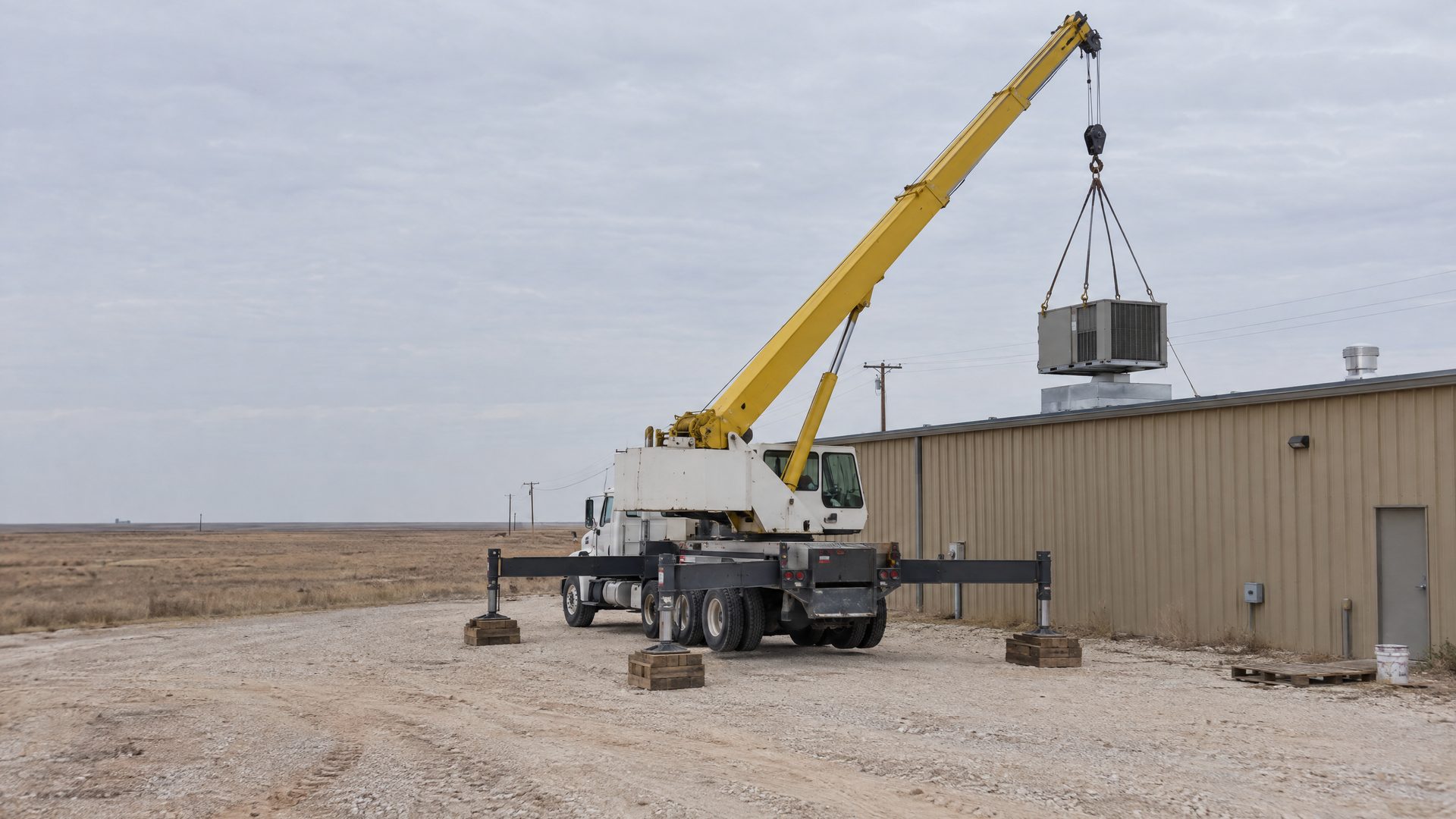
A hydraulic truck crane takes the Borger lifts that can be made from pavement: a rooftop unit or a sign in town, steel for a new shop, or a load set from a paved road inside a plant. It runs up from Amarillo on its own wheels and stands on its outriggers where it parks. The open question is the street. The City of Borger's permit and right-of-way rules were not available to us online when we checked, so ask the City what it requires before a crane is booked for a street setup; whatever permit the City names then goes on the quote. Truck crane classes and load chart reading are on our Amarillo truck crane page.
All-Terrain Cranes for Heavy Picks at Borger's Plants
An all-terrain crane is the road-going answer in Hutchinson County when a pick outgrows a truck crane but the crane still has to drive to an unpaved pad or a plant road. The plant sites are large; Phillips 66 alone lists about 6,000 acres at its refinery. Height brings two checks here. The Hutchinson County Airport runway, 6,300 feet by the EDC's figure, is longer than the 3,200-foot line in 14 CFR 77.9, so if the airport is one the rule covers, a tall boom near it is measured against the FAA's 100-to-1 notice slope. Wind is the other: Liebherr says crane lifting capacity tables "generally apply in gust speeds of up to 9 m / s (20 mph)," while the fastest convective wind in the Weather Service's Panhandle records, 108 knots, came east-southeast of Borger. AT classes, counterweight loads and escorts are covered under all-terrain crane rental.
Rough-Terrain Cranes Inside Borger Plants and on River Ground
A rough-terrain crane suits Borger work where the crane stands on unpaved ground and moves between picks: inside a refinery or chemical plant, or on the broken land the Handbook of Texas describes along the Canadian River and its tributaries. It reaches Borger on a trailer and drives only inside the site. Ground preparation belongs to the controlling entity under OSHA's section 1926.1402, along with the duty to flag any void, tank or buried utility below the set-up area that its drawings or soil reports show; at a refinery dating from 1926, those records are worth asking for first. Pads, mats and RT sizes are covered under rough-terrain cranes.
Crawler Cranes for Long Plant Projects Around Borger
A crawler crane fits a Borger project only when heavy picks repeat from one prepared spot over a long stay, since it travels as several truckloads and goes together on site under OSHA's sections 1926.1403 and 1926.1404. Large plant projects do happen here: Orion Engineered Carbons reported in January 2023 that it had completed a project at its Borger carbon black plant that eliminates 23 tons of nitrogen oxide and sulfur dioxide emissions per day. A lattice boom near Hutchinson County Airport goes through the FAA's criteria, and Form 7460-1, where it is needed, goes in at least 45 days before assembly starts. Assembly, transport loads and ground bearing are covered under crawler cranes.
Boom Trucks for Borger Rooftops, Signs and Plant Supplies
A boom truck carries the lighter Borger lifts: rooftop units and signs in town, trusses and steel for new buildings, and supplies set onto a platform or into a yard at a plant. Because it is a crane on a commercial truck, it sets up from a street or a yard, and there the power line rules come first. When a boom truck works as a crane, OSHA's section 1926.1408 applies: if the boom, its load line or the load could close to less than 20 feet from a power line, the employer uses one of the rule's three options, and Texas's six-foot rule keeps the boom clear of a high-voltage line until whoever operates the line has 48 hours' notice and both sides settle on protection. The boom trucks for hire page walks through truck ratings, license classes and the published job prices.
Carry Deck Cranes for In-Plant Work Across Borger
A carry deck crane is built for the inside of plants like Borger's: Broderson lists petro-chemical work and oil refineries among the industries that use carry deck cranes, and calls its own ideal for lifting material that "requires a compact, low-profile crane." In Borger, the Phillips 66 refinery is one such plant, and the town also has the Chevron Phillips Chemical plant with its specialty chemicals and plastics, Nutrien's ammonia and urea plant and the carbon black plants of Orion and Tokai Carbon CB. A carry deck arrives on a trailer, then lifts, drives and sets under three ratings from its maker: outriggers set, pick and carry, and load riding the deck. Those ratings, widths and OSHA's rules for traveling with a load are explained under carry deck cranes.
Rigging and Lift Plans for Borger Plant Picks
A written lift plan puts a Borger plant pick on paper before the crane arrives: the load's weight from a source the industry recognizes, the rigging, the crane's position and radius, the swing area and the signals. ASME P30.1 sorts plans into two categories, "Standard Lift Plan and Critical Lift Plan," by the nature of the lift and the exposure involved. Inside a plant, using the Table A distance in OSHA's section 1926.1408 means knowing each line's voltage, and when that option is used the utility owner or operator must answer a voltage request within two working days. Wind goes in the plan too, and OSHA's section 1926.1417(n) puts the adjustment for it on the competent person. Signals, signal persons and rigger qualifications are covered under lift planning and rigging service.
Heavy Haul to Borger Under TxDMV Permits
Heavy haul for Borger means about 50 miles from Amarillo, going by the distance Phillips 66 gives for its refinery, then a plant gate. A crane over legal width or weight can travel under TxDMV's yearly unladen lift equipment permit, a $100 fee good for one year from the movement-to-begin date, or under a single-trip mileage permit with a $31 minimum fee, valid for up to seven consecutive days. With the annual permit, TxDMV tells the holder, "You are responsible for routing and obtaining current restrictions prior to movement." Inside the fence, a carry deck or rigging takes the load from the trailer to its set point. Escorts, flags, curfews and holiday limits are set out under heavy haul and machinery moving.
Heavy Equipment Rental in Borger and Hutchinson County
Equipment for a Borger job travels out from Amarillo on a trailer for a day, a week or a month, and the quote lists the delivery and the pickup. The manufacturer's operating information rides with each machine, and for forklifts, telehandlers and aerial lifts we ask that the operator hold the training OSHA and ANSI/SAIA require. Before any digging, Texas 811 needs at least two business days' notice, weekends and holidays not counted, and its FAQ asks for a fresh notice if the start slips more than fourteen days.
Excavators for Borger Trenches, Footings and Plant Work
An excavator in Borger digs trenches for water, sewer and service lines, footings and plant foundations, in a county the Handbook of Texas treats as the Panhandle's hub of oil, gas and petrochemical production. Locates come before the bucket. Texas 811's excavator FAQ sets the tolerance zone for a pipeline at "a minimum of 18 inches on either side of the outside edge of the underground pipeline," and its excavator page says that if a gas line is hit or damaged, "you must also call 911." In town, the City of Borger's digging and right-of-way rules were not available online when we checked, so ask the City before you open a street. See excavator sizes and OSHA's trench rules before you book.
Skid Steers and Track Loaders for Borger Yards and Storm Cleanup
Around Borger, a skid steer or compact track loader moves material, spreads base and clears debris on yards, lots and plant grounds, storm cleanup included; the National Weather Service tied the Aug. 2, 2025 storm to damage "consistent with 70-80 mph winds" in Fritch and parts of Borger. One rule question comes up at plants: OSHA's October 21, 1999 letter says skid-steer equipment that is earthmoving equipment falls outside the forklift standard, but if it is not earthmoving equipment it is covered. Tires or tracks turns on the surface, paved yard or soft ground; ground pressure, rated operating capacity and rental terms are compared under skid steers and track loaders.
Telehandlers for Borger Plant Materials and Building Work
A telehandler places loads up and out from rough ground, such as materials onto a plant platform or framing onto a new building in Borger. At a plant, the line between a telehandler and a crane matters: OSHA's crane FAQ calls equipment "designed to function as both a crane and a forklift" multi-purpose equipment, and OSHA's June 21, 2012 letter says such equipment is covered by the crane standard "when configured, and operated as, a crane." OSHA's forklift eTool lists a "Variable reach type" among Class VII rough terrain trucks, one "equipped with a telescoping boom," and its powered industrial truck rule has each operator trained and then evaluated at least every three years. Capacities at height and at reach are listed under telehandler capacities.
Boom Lifts for Overhead Work in Borger's Plants
Overhead work at a Borger refinery, chemical plant or building calls for a boom lift when the worker has to go up and over an obstruction; OSHA's aerial lift rule names both "Articulating boom platforms" and "Extensible boom platforms." Section 1926.453 lets only authorized persons operate the lift, says "Lift controls shall be tested each day prior to use," and holds the load to the boom and basket limits the maker sets. OSHA's aerial lift fact sheet sets 10 feet as the minimum distance from overhead lines, Texas's chapter 752 adds its six-foot law and 48-hour notice for high-voltage lines, and the same fact sheet says not to operate in high winds above the maker's recommendation. Platform heights and the articulating or telescopic choice are laid out under boom lift heights and types.
Scissor Lifts for Indoor Work in Borger Buildings
A scissor lift is the rental for straight-up work from a level floor in Borger: ceilings, lighting and walls inside shops, warehouses, plant buildings and the 25-bed Golden Plains Community Hospital facility that opened in 2011. OSHA's hazard alert on scissor lifts lists four construction standards that apply to them, from 1926.21 on safety training to 1926.454 on training requirements, and OSHA's eTool says they "must have guardrails installed to prevent workers from falling." Outdoors, the same eTool says lifts rated for outdoor use are generally limited to winds below 28 miles per hour. Slab against rough-terrain models are compared under scissor lifts by height.
Forklifts for Borger Plant Warehouses and Yards
A forklift moves palletized material through Borger's plant warehouses, stores and yards, a cushion-tire truck on smooth floors indoors and a pneumatic-tire or rough-terrain truck on gravel outside. OSHA's section 1926.602 requires the rated capacity to be posted on the truck where the operator can see it, and bars changes that affect capacity or operation without the manufacturer's written approval. Training comes first under OSHA's rule 1910.178(l): the employer certifies that each operator has been trained and evaluated, and repeats the evaluation "at least once every three years." Model capacities and mast heights are set out under forklift sizes and masts.
Backhoes and Wheel Loaders for Borger Lines and County Roads
A backhoe loader digs, loads and backfills in one visit, which fits a single service-line repair in a Borger street or a ditch beside a Hutchinson County road. Work along a county road is a question for the Hutchinson County Road and Bridge office, which the county directory lists at its Borger Annex, and Texas 811 comes first either way. A wheel loader, built to scoop and carry rather than dig, handles stockpiles and bulk material on plant and county yards. If a buried line is struck, Utilities Code section 251.159 makes the excavator report the damage to the facility operator at once and hold off backfilling until a repair schedule is agreed. CASE and Volvo figures sit under backhoe and loader choices.
Dozers for Borger Pads and Broken Canadian River Ground
A dozer cuts, fills and grades around Borger, where Hutchinson County's land runs from 2,750 to 3,400 feet above sea level and breaks into valleys along the Canadian River and its tributaries, by the Handbook of Texas's account. In oil and gas country, one 811 exemption is narrower than it sounds: Utilities Code section 251.156 excuses oil and gas exploration and production work from the notice rule only where it is not conducted within an underground facility easement or right-of-way. OSHA's section 1926.1000 counts crawler tractors among the machines its rollover-protection rules reach, and section 1926.602 adds seat belts. Blade capacities and the published rate range are on our dozer sizes and rates page.
City, County, State and FAA Rules for a Borger Lift
No City of Borger permit, right-of-way or street-closure rule was available to us online when we checked, and no Hutchinson County permit page turned up either. The county directory lists a Road and Bridge office at its Borger Annex, and the courthouse stands at 500 Main Street in Stinnett, the county seat. Call the City before a crane is booked for a Borger street and the county office before work along a county road; any permit either one requires goes on the written quote.
State and federal rules carry the rest. Oversize moves on State highways 136, 152 and 207 run under TxDMV permits, and TxDMV posts permit restrictions for the Amarillo district, which TxDOT's district profile says covers Hutchinson County. Before the lift we check the overhead lines and the airport criteria and tell you what has to be arranged and who arranges it; our guide to Panhandle crane permits and power line law sets out each rule.
- Section 752.004 of the Texas Health and Safety Code: no work where a person could "move or be placed within six feet of a high voltage overhead line," or bring equipment that close, unless guarded under section 752.003.
- Section 752.003: the party responsible notifies the line's operator "at least 48 hours before the work begins" and pays the operator's actual cost of the clearance.
- OSHA section 1926.1408: where a crane or load could come nearer than 20 feet to a line up to 350 kV, the employer confirms the utility has deenergized and grounded it, keeps 20 feet away or uses Table A's distance.
- Texas 811: notice at least two business days before digging, not counting weekends and holidays; having the lines marked is a free service.
- FAA rules 14 CFR 77.9 and 77.7: equipment over 200 feet above ground, or above a covered airport's notice slope, needs Form 7460-1 filed 45 days or more ahead.
Borger FAQs
How far is Borger from Amarillo for a crane delivery?
About 50 miles, going by Phillips 66, which places its Borger Refinery approximately 50 miles north of Amarillo; the Borger EDC puts Rick Husband Amarillo International Airport just over 40 miles from town. Self-propelled truck and all-terrain cranes drive it, trailers carry the rest, and TxDMV permits cover anything oversize or overweight. The trip is priced as a separate line on our written quote, so you can see what the distance adds.
Does the City of Borger require a permit for a crane on a street?
We could not read the City of Borger's permit rules online when we checked, so ask the City before you set the date. If the crane will stand in a traffic lane or on a sidewalk, its answer decides the schedule, and any permit it requires appears on our written quote. For a county road, the Hutchinson County Road and Bridge office at the Borger Annex is the contact. Oversize moves on the state highways into town, 136, 152 and 207, need TxDMV permits.
Can a crane be used near the Hutchinson County Airport?
Yes, after the FAA's notice criteria are checked. The Borger EDC describes the airport's lighted runway as 6,300 feet, longer than the 3,200 feet at which 14 CFR 77.9 switches to its 100-to-1 notice slope, so if the airport is one the rule covers, that slope reaches out 20,000 feet from its runway. Anything over 200 feet above ground level needs notice wherever it stands. When notice applies, the FAA needs Form 7460-1 a minimum of 45 days ahead, and we tell you whether it applies before a date is set.
How windy does it get for crane work around Borger?
Windy enough that every lift plan needs a stop point. The National Weather Service's storm climatology for the Panhandles records the fastest convective wind in its area, 108 knots, about 10 miles east-southeast of Borger on April 6, 2001, and the Aug. 2, 2025 storm did damage in parts of Borger that the Weather Service matched to 70-80 mph winds. Over the year, Amarillo's National Weather Service normals average 13.6 mph. The competent person adjusts the crane and the work for wind under OSHA's section 1926.1417(n); when wind makes a pick unsafe it stops, the lift is rebooked, and standby follows the terms in the written quote.
Get Your Free Borger Quote
Free quote