Crane Rental in Pampa, TX
Crane rental in Pampa means a crane or machine sent about 55 miles northeast from Amarillo, the distance the Pampa Economic Development Corporation (EDC) gives, to the county seat of Gray County. The Census Bureau's QuickFacts for Pampa show 16,867 in the April 1, 2020 Census and an estimate of 16,414 for July 1, 2025. What decides a job here is what the county runs on, which the Handbook of Texas sums up as "a mix of oil, petrochemicals, farming, and ranching," plus a busy BNSF main line, an airfield northwest of town, the City of Pampa's Permit Manual and the Panhandle wind.
An operated rental is a crane that comes with its operator, billed by the hour with a minimum. A bare rental sends the machine with nobody to run it, so the person at the controls is yours and must meet OSHA's operator rule in section 1926.1427. To price a Pampa lift, send us the load's weight, the pick point and the landing spot, what the crane will stand on, any lines overhead, the street address and your dates. For a rented machine, tell us the work, the ground and how many days or weeks. Before anything leaves Amarillo, you get a written quote at no charge that names the crane class or the machine, whether it is operated or bare, the hour minimum or rental period, travel, any permits, mats or escorts, and each charge with any tax line.
a free written quote before any lift or delivery is booked.
Free quote
What Pampa's Oil, Rail, Airfield and Gray County Ground Mean for a Lift
Oil and chemicals built Pampa. The Handbook of Texas says "The discovery of oil in 1926 caused Pampa to grow," and the Pampa EDC's history page dates the county's first oil well to January 31, 1925. The Handbook's Gray County entry describes "a substantial petrochemical industry" making carbon black and other synthetic materials, and its Pampa entry notes that "the Celanese Corporation of America built plants in the vicinity." The EDC's history page also lists Cabot Corporation, Celanese, carbon black plants and National Oil Well Varco, but it does not say which still operate, so we name none of them as a current site. Plant work of that kind, moving vessels, pumps and motors inside a fence line, is where carry decks, riggers and planned picks come in.
The Pampa EDC's own industrial tract is the Pampa Energy Center, which the EDC's properties page places "five miles west of Pampa on HWY 60." The EDC bought it in May 2011 and lists "approximately 4,000 acres of land with 5,500 acres of water rights," with "Five miles of rail" on the property served by Burlington Northern Santa Fe. Any build on acreage of that size would start with a hauled crane, ground mats and earthmoving machines. OSHA section 1926.1402 puts the crane's ground on whoever controls the project: it has to be "firm, drained, and graded" enough to meet the maker's support specifications before the crane is set up or used.
Trains and aircraft are the two kinds of traffic a Pampa lift plan has to respect. The EDC's community information page says the town is "on the main Burlington Northern Santa Fe rail line" and that "Approximately 80 trains come through Pampa daily." Pampa has been a rail town since 1887, when the Handbook says it was "designated as a station on the Southern Kansas Railway." The same EDC page puts Perry Lefors Field "five miles northwest of Pampa in Gray County" and lists runway 17/35 at "5862 x 100ft." and runway 5/23 at "4500 x 75ft." A tall lift near either one is planned well before the date: where the FAA must be notified, the notice is due at least 45 days ahead under 14 CFR 77.7.
Gray County's terrain varies from place to place. The Handbook of Texas puts its elevation at "2,500 to 3,300 feet above sea level," describes "sandy loam and black waxy soils," places the county "at the head of the North Fork of the Red River," and has McClellan Creek flowing "northeastward across the southern part of the county." Which of those soils sits under the outriggers (the arms that reach out from the crane's frame and carry it on pads) decides whether the quote adds mats or cribbing. For wind, the figures here are Amarillo's, from the National Weather Service station there: its 1991-2020 normals average 13.6 mph, with March and April the windiest months, and the Amarillo airport's sensor measured a record-breaking 83 mph on March 14, 2025. The monthly table is on our Amarillo wind and weather data page.
See Pampa, TX on Google Maps — we quote work across the area from Amarillo.
Cranes for Pampa Lifts, From Truck Cranes to Heavy Haul
Every crane below reaches Pampa from Amarillo, so even a short pick in town carries the trip on its quote. The size comes from the load chart, the crane maker's capacity table for each boom length and radius (radius being the level distance from the crane's center of rotation to the hook), not from the tonnage in the crane's name. Each sub-section says what the class does in Pampa and Gray County and links the page that holds its specifications, published rates and rules.
Truck Cranes for Pampa Signs, Rooftops and Steel
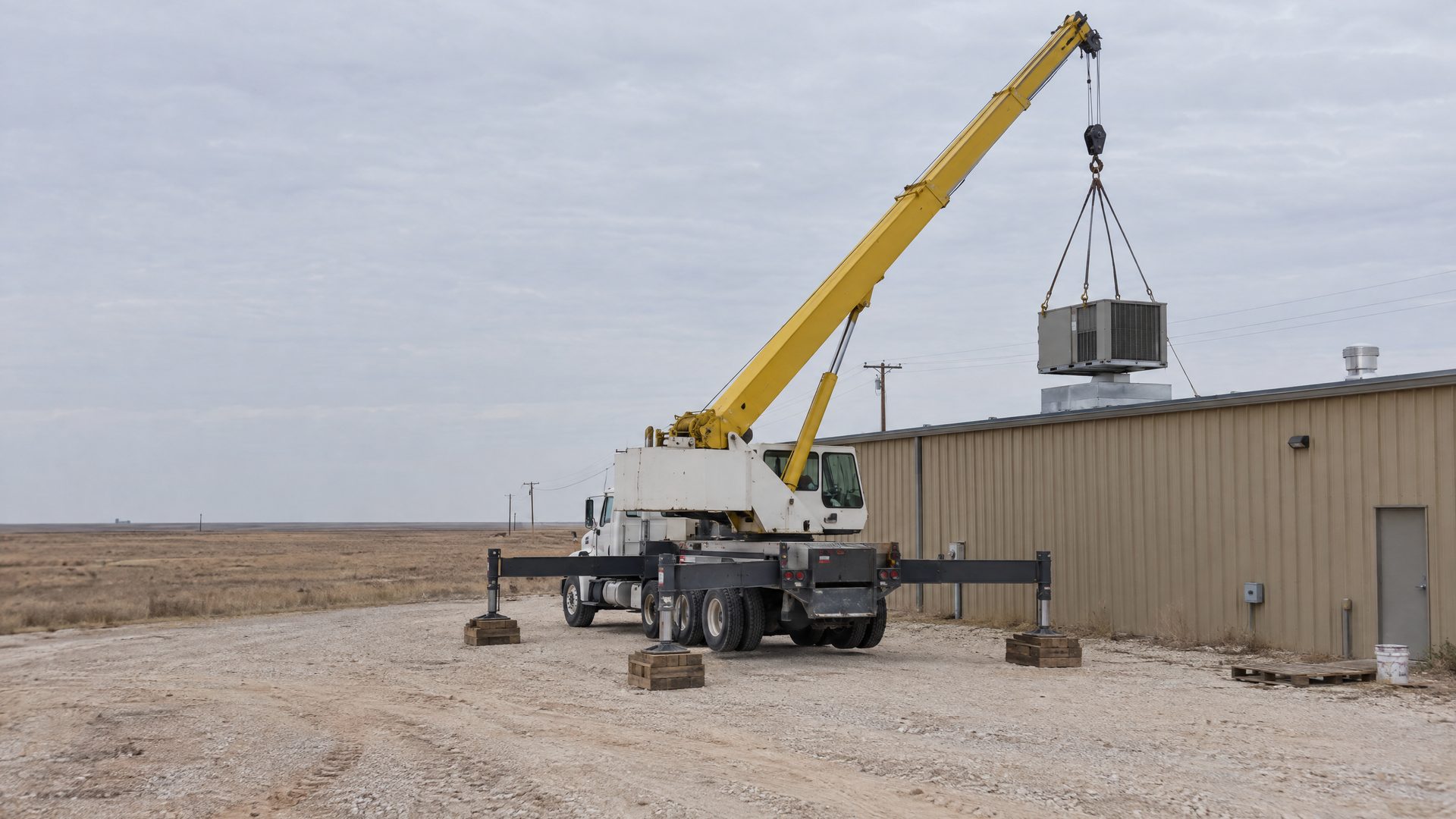
A mobile crane fits a one-day lift in Pampa: the hydraulic truck crane drives over from Amarillo on its own chassis, sets its outriggers in a lot or at the curb, and leaves when the load is down. Loads it suits include signs, rooftop units, beams and tanks. The City of Pampa's Permit Manual, dated September 2024, says "All commercial work is required to be performed by licensed contractors," and it charges added permit fees for signs, so a new sign has a City permit step of its own before the crane is booked. We found no readable copy of Pampa's street rules online, so if the crane must stand in a street, ask the City's Action Center first. Example truck cranes and their charts are on the mobile crane rental page.
All-Terrain Cranes for Heavy Picks Around Pampa
An all-terrain crane fits a Pampa job whose load outweighs or outreaches a truck crane and whose site is off the pavement, because the class travels at highway speed yet steers all its axles across a rough site. Industrial acreage such as the Pampa Energy Center, which the EDC places five miles west of town on US 60 with BNSF-served track on the property, could be that kind of site, with long reaches over rail and access that may be dirt. Big AT cranes bring part of their counterweight (the added weight that keeps a crane stable) on separate trucks, and those trucks need TxDMV permits when they exceed legal size or weight. The all-terrain crane rental page compares the class with truck and crawler cranes.
Rough-Terrain Cranes on Gray County Lease and Ranch Ground Near Pampa
A rough-terrain crane is the hauled-in choice for Pampa-area work on unpaved ground, such as oil leases, ranch yards and open industrial tracts, since its all-wheel drive and all-wheel steering handle footing that a truck crane's carrier should avoid. The class is slow on the road, so it rides a trailer from Amarillo, and that haul is a line on the quote. Ground decides the setup. The Handbook of Texas describes Gray County's "sandy loam and black waxy soils," and OSHA section 1926.1402 makes the project's controlling entity provide the ground preparation a crane maker's support specifications call for. Before a pad is chosen, we ask what it stands on and how it drains. Example RT models are on the rough-terrain crane rental page.
Crawler Cranes for a Long, Heavy Pampa Project
A crawler crane comes to Pampa only for a long, heavy project, because a lattice-boom crawler is trucked in as one main load with separate overflow loads and then assembled on site. No project of that size in Pampa appears in our sources. If one is built, OSHA sections 1926.1403 and 1926.1404 require the assembly to follow the maker's or the employer's procedures under an assembly/disassembly director, and the tracks need firm, graded ground, with mats where it calls for them. A boom that tall near Perry Lefors Field would also get a 14 CFR 77.9 check before the crane is ordered. The crawler crane rental page covers transport loads, assembly and ground bearing.
Boom Trucks for Pampa Ranch, Shop and Sign Work
Light lifts around Pampa suit a boom truck, which hauls the cargo on its own bed and lifts it off with a crane built onto the same chassis: ranch equipment, shop machinery, trusses, a sign on its pole. Farming and ranching sit beside oil and petrochemicals in the Handbook of Texas's summary of the Gray County economy, and on a ranch or farm job one truck can haul the load and set it in a single visit. When the weight or reach goes past what the boom is rated for, the next step up is a truck crane. Truck ratings, CDL rules and job-guide prices are on the boom truck rental page.
Carry Deck Cranes Inside Pampa Plants and Shops
For Pampa's plants, shops and warehouses the small crane is a carry deck, which picks a load, rides it down an aisle on its own deck and sets it where a truck crane could not fit. That is the work a petrochemical plant generates when a pump, motor or valve has to move inside the fence, and the Handbook of Texas describes Gray County's industry as one "that produces carbon black and other synthetic materials." Our sources do not say which plants on the EDC's history list still run, so we name none as a site. Borger also has carbon black and chemical plants; see our Borger crane rental page. Deck, pick-and-carry and outrigger ratings are on the carry deck crane rental page.
Lift Planning for Pampa Picks Near Rail and Runways
A lift plan for a Pampa job can carry two local items: a main-line railroad and an airfield. The EDC says about 80 trains a day pass through on the BNSF main line, so a pick beside the tracks starts with a call to the railroad, and the plan draws the swing to keep the load clear of it. Perry Lefors Field lies five miles northwest of town; the FAA's 14 CFR 77.9(b)(1) draws an imaginary 100-to-1 surface that runs 20,000 feet out from the closest runway of an airport the rule covers "with its longest runway more than 3,200 ft.," and the EDC lists runway 17/35 at "5862 x 100ft." The EDC page does not say whether the field is an airport the rule covers, so that is part of the FAA check we run before a tall lift. ASME P30.1 sorts plans into a "Standard Lift Plan and Critical Lift Plan," and the rigging and lift planning page explains both, with signal persons and rigging weight.
Heavy Haul and Machinery Moving In and Out of Pampa
Heavy haul to Pampa can run on US 60 from Amarillo, the highway that also serves Panhandle and Carson County, or on the state highways that meet it in town, State Highways 70, 152 and 273. Without a permit, TxDMV lets a load reach 80,000 pounds gross, 14 feet tall and 8 feet 6 inches wide, with caps on each axle group too; past any of those, it moves on a TxDMV permit. Interstate 40 crosses the far southern part of Gray County, per the Handbook of Texas, for loads coming from east or west. Inside the city, the Permit Manual charges added fees for moved buildings, so moving a structure is a City matter as well as a road one. Shifting a machine inside a plant is a different job, done with a carry deck or a rigging crew; see heavy haul and machinery moving for both kinds of move.
Heavy Equipment Rental for Pampa and Gray County Jobs
The eight machines below rent by the day, week or month and reach Pampa on a trailer from Amarillo. Each is matched to Pampa work: city lots and curbs, ranch and lease ground, plant yards and the rail-served land west of town. Specs, published national rates and the OSHA rules for each machine sit on its own page, linked from its sub-section. Before any digging, you or we call Texas 811, and Texas811 says the law wants that call "at least two business days before excavating," with weekends and holidays left out of the count.
Excavators for Pampa Service Lines, Curbs and Pads
An excavator rental in Pampa can be a mini excavator for a service line, footing or curb approach in town, or a full-size machine for pipe, tank and pad work on lease and industrial ground. In the city, the Permit Manual says "You need a permit only if you are removing the curb or replacing the" approach area, and it adds permit fees for driveways, so a curb cut or new drive starts at the Action Center. Once the 811 tickets are marked, OSHA's excavation rule, 29 CFR 1926.652, requires a cave-in protective system in any trench 5 feet deep or more unless it is cut in stable rock. Sizes, dig depths and rates are on the excavator rental page.
Skid Steers and Track Loaders for Pampa Lots and Pens
A skid steer or compact track loader does the cleanup, grading and material moving on Pampa lots, ranch pens and demolition sites. The soil and the last rain pick the undercarriage: on the "sandy loam and black waxy soils" the Handbook of Texas lists for Gray County, a track loader spreads its weight over more ground than a wheeled skid steer, which helps on soft footing, while wheels suit pavement and hard yards. OSHA section 1926.1000 extends its rollover-protection rule to rubber-tired skid-steer equipment made after July 15, 2019 that is used in construction. See the skid steer and track loader rental page for ratings, ground pressure and rates.
Telehandlers for Pampa Commercial Builds and Yards
A telehandler, a forklift with a telescoping boom, sets roofing, block and steel on a Pampa commercial building and loads trucks over their sides in a yard. Building work in Pampa runs under the City's adopted codes; its codes page lists the 2018 International Building Code as enforced from May 1st 2018, while the same page also says the City adopted the 2015 codes, so confirm the edition with the City. OSHA's June 21, 2012 letter puts equipment designed to work as both a crane and a forklift under the crane standard "when configured, and operated as, a crane," but says a typical forklift with a designated forklift boom, which "was not designed to provide powered horizontal and vertical movement of the load," is not covered. Capacities at full height and full reach are on the telehandler rental page.
Boom Lifts for Pampa Signs, Lights and Building Faces
A Pampa sign, light pole or building face is boom lift work: the platform swings a worker up and out, reaching over a curb, a canopy or a parked truck where a scissor lift cannot. Where a sign stands under or beside wires, Texas law (Health and Safety Code, chapter 752) sets a six-foot limit: no worker, basket or boom inside that distance of a high-voltage line before the operator of the line has been told 48 hours ahead and a barrier, a de-energized span or a raised line is arranged. Across the Panhandle, wind is the limit to watch: OSHA's aerial lift fact sheet says not to operate "in high winds above those recommended by the manufacturer." Heights and outreach for each class are on the boom lift rental page.
Scissor Lifts for Pampa Renovation and Interior Work
Inside a Pampa building, ceilings, lights, sprinklers and ductwork are scissor lift work: the platform rises straight up on a firm floor, with guardrails around its deck. Interior work often comes with a renovation, and the City's Permit Manual says "A City of Pampa permit is required before renovating or demolishing a public or" commercial building, so that permit comes before the lift arrives. OSHA's August 1, 2000 letter treats scissor lifts as mobile scaffolds rather than aerial lifts, and its eTool says outdoor-rated models are "generally limited to wind speeds below 28 miles per hour." Platform heights and slab or rough-terrain models are on the scissor lift rental page.
Forklifts for Pampa Warehouses, Yards and Rail Freight
A forklift in Pampa unloads and stacks freight in a warehouse or a supply yard, and the floor decides the type. Toyota says its cushion tires are "specifically designed for smooth indoor surfaces" and calls pneumatic tires "ideal for outdoor environments with gravel, dirt, or uneven surfaces." OSHA's eTool files rough-terrain forklifts as Class VII, "typically intended for use on unimproved natural terrain." On a rail-served tract such as the Pampa Energy Center, ask whether the unloading area is paved before choosing tires. OSHA's 29 CFR 1910.178(l) requires each operator to be trained and evaluated, with a performance review "at least once every three years." Mast heights and capacity ratings by model are on the forklift rental page.
Backhoes and Wheel Loaders for Pampa Utility and Ranch Jobs
A backhoe loader suits Pampa jobs that dig and then backfill in one visit, a water or sewer service, a culvert or a broken line, while a wheel loader moves gravel, feed or spoil in volume on ranch and lease ground. The City's streets page and code of ordinances could not be read when we gathered facts, so a dig in a Pampa street or alley starts with a call to the Action Center, open Monday through Friday, 8:00 am to 4:00 pm, as the City lists it. Texas811's FAQ says APWA and industry practice set "18 inches on either side of the marked utility" as a reasonable tolerance zone. Dig depths and bucket sizes are on the backhoe and loader rental page.
Dozers for Pampa Demolition Lots, Pads and Lease Roads
A dozer in Pampa clears and grades: a building pad, a lease road, a stock tank dam or the lot left after a demolition. Demolition inside the city follows its own order. The Permit Manual requires a City permit before a public or commercial building comes down, and its submittal list calls for an "Asbestos survey for building and demolition permits for existing building," so the dozer is booked once both are in hand. Out in the county, check whether a cut sits near McClellan Creek or another drainage before the blade moves, and give Texas 811 its two business days wherever buried lines may run. Blade sizes and the dozer range are on the dozer rental page.
Permits, Roads, Rail and Power Lines for Pampa Lifts
The City of Pampa runs permits through its Action Center, which the City's Code Enforcement page lists at 200 W Foster Ave Room 204, open Monday through Friday. The parts of the City's September 2024 Permit Manual in our sources deal with buildings, curbs and moves rather than cranes: licensed contractors for commercial work, a permit before renovating or demolishing a public or commercial building, an asbestos survey for existing buildings, a curb permit only when the curb is removed or the approach replaced, and added fees for "Driveways, Moved Buildings, and Signs." We could not read the City's streets page or its ordinances, so this page states no Pampa rule for a crane in a street; ask the Action Center before the date.
State and federal rules cover the rest. Roads: Pampa sits at the junction of US 60 and State Highways 70, 152 and 273, and any crane or load beyond Texas's legal size or weight moves on a TxDMV permit. Overhead lines: a Texas statute, Health and Safety Code chapter 752, forbids work that could put a tool, machine or load inside six feet of a high-voltage line without 48 hours' notice to whoever operates it and a protective arrangement in place, and OSHA section 1926.1408 starts with a distance test: might any part of the machine, its load line or the load come nearer than 20 feet to a line? Airspace: FAA notice under 14 CFR 77.9 goes in on Form 7460-1. We run each of those checks before the date and say who has to arrange what; the state and federal rules guide sets them out in full.
- City of Pampa building codes: the codes page lists the 2018 International Building Code as enforced "Beginning on May 1st 2018" and also says "The City of Pampa has adopted the 2015 International Building Codes."
- BNSF main line: "Approximately 80 trains come through Pampa daily," per the Pampa EDC's Community Information page.
- Perry Lefors Field, "five miles northwest of Pampa": runway 17/35 "5862 x 100ft." and runway 5/23 "4500 x 75ft." as the Pampa EDC lists them.
- Texas 811: a locate request "at least two business days before excavating," excluding weekends and holidays, per Texas811.
- TxDMV holiday rule: "Vehicles and loads exceeding 14 feet wide, 16 feet high, or 110 feet long may not be moved" on the listed holidays, Thanksgiving Day (11/26/2026) among them.
Pampa FAQs
Do you bring cranes to Pampa from Amarillo?
Yes. Pampa is about 55 miles northeast of Amarillo by the Pampa EDC's measure, and a truck crane or all-terrain crane drives there on US 60, while rough-terrain cranes, crawlers and rented machines ride a trailer. Travel is its own line on the written quote, beside the crane's class and tonnage, whether it comes with an operator, the hour minimum and any permit or escort. For published national rates and how travel time is usually billed, see the crane and equipment cost page.
Do I need a City of Pampa permit to use a crane?
We found no City of Pampa permit for a crane as such, but the work a crane serves often needs one. The parts of the City's Permit Manual in our sources cover commercial building work, renovation and demolition, curb and driveway work, moved buildings and signs, and the manual requires licensed contractors for commercial work. The City's street rules were not readable online when we checked, so if a crane or truck must stand in a street, call the Action Center before the date.
Can a crane work near Perry Lefors Field in Pampa?
That turns on the crane's height under the FAA's notice rule. Under 14 CFR 77.9 the FAA must hear about construction "more than 200 ft. AGL at its site," and, near a covered airport whose longest runway passes 3,200 feet, about anything breaking a surface that climbs at "100 to 1 for a horizontal distance of 20,000 ft." from the nearest runway. The Pampa EDC page does not say whether the field is a covered airport, so that is part of the check. The notice goes on FAA Form 7460-1, which 14 CFR 77.7 says to submit "at least 45 days before the start date" of the work. We run that check before any tall lift on the northwest side of town.
What ground problems can stop a crane setup around Pampa?
Footing that is soft, wet or out of level under the outriggers. The Handbook of Texas describes Gray County's sandy loam and black waxy soils and creeks such as McClellan Creek, and OSHA section 1926.1402 bars using a crane unless the ground, with mats or blocking if needed, meets the maker's specifications for support and level. The project's controlling entity must provide that preparation. We ask what the pad is and how it drains, and the quote lists any mats or cribbing (stacked timbers or mats that spread each outrigger's push across more ground).
Get Your Free Pampa Quote
Free quote