Crane Rental in Canyon, TX
Crane rental in Canyon means a crane or machine sent 15 miles south from Amarillo on Interstate 27, the distance West Texas A&M University gives for its college town, to a job in the county seat of Randall County. The Handbook of Texas places Canyon at the junction of U.S. Highway 60 and Interstate 27, near the center of the county. The Census Bureau put the city's population at 14,836 in the 2020 Census and estimated 16,518 for July 1, 2025. The work follows the town's mix: a university campus, a dairy-products plant that KFDA reported in 2017, farm and ranch land across the county, an I-27 widening that KFDA reported as starting in July 2024, and canyon country to the east.
Below, our eight crane services and eight equipment rentals are taken one at a time and tied to Canyon's own sites, ground and roads, each with a link to the page holding that class's specifications, published rates and general rules. A crane comes operated, its operator billed by the hour against a minimum, or bare, as the machine alone. Machines rent on daily, weekly or monthly terms. Pricing begins with a written quote that costs you nothing, and a crane quote starts from your answers to a few questions. How heavy is the load? Where does it start, and where must it land? What will the crane stand on, and how does it get in? Are wires overhead? What is the address, and which dates suit you? A machine quote needs the work, the ground and the length of the rental.
a free written quote before any lift or delivery is booked.
Free quote
Campus, Dairy, Interstate and Canyon Rim: Canyon's Job Sites
West Texas A&M University, established in 1910, counts 61 buildings on a 342-acre residential campus and a fall 2025 enrollment of 9,257 on WTAMU's Quick Facts page. A university news story in April 2026 on its One West campaign describes a renovation of the Geneva Schaeffer Education Building and notes that the Bain Athletic Complex officially opened in July 2024. A WTAMU news story of November 10, 2025 reports that the university broke ground on a research feedlot and educational complex on land near the Nance Ranch, which the story places about seven miles east of Canyon; the plans include cattle pens, an animal-processing facility, a feed mill and an education center. The university expected work on the education center to begin that winter and on the feedlot later in 2026.
Dairy processing and farming have a history here too. KFDA reported in 2017 that Lone Star Dairy Products had built a plant in Canyon to process butter, cream and powdered milk, and Dairy Foods wrote in April 2018 that the plant made "low-spore milk powders" from "approximately 2.5 million pounds of locally sourced milk per day." The Handbook of Texas says the economy after World War II depended on "wheat, grain sorghums, dairy products, and livestock," calls Randall County's economy "agribusiness, education, tourism, and some manufacturing," and counts 613 reported businesses in Canyon in 2023.
Interstate 27 runs between Amarillo and Canyon, and KFDA's reporting has it under construction through 2028. TxDOT's I-27 project page covers about 8.8 miles "from north of Western Street in Amarillo to south of the US 60 Interchange, north of Canyon," to "Upgrade I-27 from four mainlanes to six mainlanes" and improve the frontage roads from rural to urban design. KFDA reported in July 2024 that TxDOT was starting the widening, on a schedule of "about four and a half years" with completion in "December of 2028." Nearer Amarillo, TxDOT lists Phase II of the Loop 335 and I-27 South interchange as fully funded, with construction to begin in 2028. U.S. 60, which also runs through Hereford, crosses I-27 at Canyon, and WTAMU notes "easy 100-mile access south to Lubbock."
East of town the plains break into canyon country. The Handbook of Texas puts the head of Palo Duro Canyon in Randall County, "fifteen miles southeast of Amarillo," and says the canyon stretches "almost 120 miles" and "reaches depths of 800 feet from rim to floor," carved into the eastern Caprock escarpment; WTAMU places it 12 miles east of Canyon. Palo Duro Canyon State Park, run by Texas Parks and Wildlife, opened in 1934, the Handbook adds. For a site near the rim or a side draw, we ask about access, slope and turning room before a crane, a trailer or a dozer is sent. In town, the Panhandle-Plains Historical Museum, established in 1932, stands on the WTAMU campus and describes itself as "the largest history museum in Texas, with more than two million artifacts."
Canyon has no weather normals of its own in our sources, so we plan with the National Weather Service's figures for Amarillo, 15 miles north. The 1991-2020 normals there average 13.6 mph of wind for the year, with March and April the windiest months. Hail is the warm-season risk: the NWS Panhandles climate guide says "93% of all hail events occur between May and September," and its storm study logged the largest hailstone of its period, "120.65 mm (4.75 in)," which "occurred 1.6 km (1 mi) southeast of Canyon on May 24, 1996." Our wind and weather records for Amarillo give the tables a lift plan draws on.
See Canyon, TX on Google Maps — we quote work across the area from Amarillo.
Crane Classes Matched to Canyon Jobs
Each crane below is read against Canyon's work: campus buildings, a food plant, farm and ranch sites off county roads, and the I-27 corridor. Any class comes operated or bare. Rented bare, the crane needs an operator of your own who satisfies OSHA section 1926.1427, meaning training, certification or a state or local license where one is issued, and an evaluation, so we ask who that will be. Load charts, specifications and published rates stay on each class's own page, linked in each part.
Truck Cranes for One-Day Lifts in Canyon
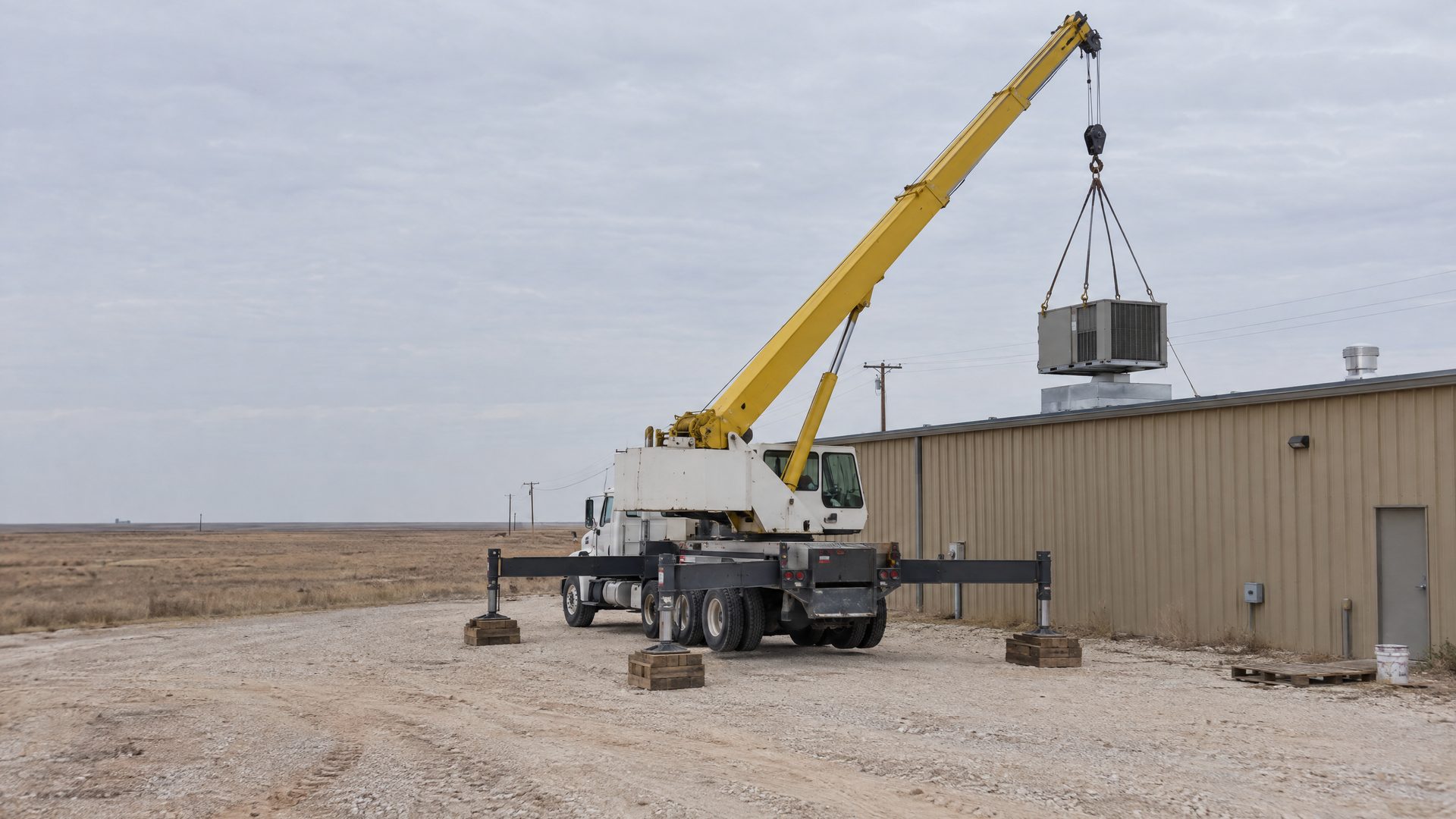
A one-day lift in Canyon suits a hydraulic truck crane, which drives the 15 miles from Amarillo on I-27 and lifts from its own outriggers, the steel legs it extends and sets on pads. Typical picks are signs, rooftop units and steel for local businesses, and short lifts beside campus buildings. If the I-27 widening KFDA reported in 2024 is still under way, the drive passes its work zone, and the written quote lists travel as a separate charge. A crane set up on a Canyon street may need the City's approval; we could not read the City of Canyon's permit pages online when we checked, so we ask the City what the setup requires before the date is fixed. Sizes, load charts and national hourly ranges are on the truck crane rental page.
All-Terrain Cranes for Larger Canyon Builds
Canyon jobs step up to an all-terrain crane when the pick outgrows a truck crane in weight or reach and the crane still has to drive itself down the highway. New buildings and big equipment sets are the usual reasons. WTAMU's planned research complex near the Nance Ranch, east of town, is to include a feed mill and an animal-processing facility, and campus work under the One West campaign can mean a long boom reaching over an existing building. An AT drives a graded, unpaved site road better than a truck crane, and its counterweight may follow on separate trucks that each meet TxDMV's limits or carry a permit. All-terrain crane rental covers sizes, road travel and escort rules.
Rough-Terrain Cranes on Unpaved Ground Near Canyon
Off the pavement around Canyon, on farm, ranch or feedlot ground reached by county roads, the rough-terrain crane is the class to send: it drives and sets up on dirt, though it is too slow for the highway and comes on a trailer. Playas are the ground to watch. Texas Parks and Wildlife describes them as "shallow, circular-shaped wetlands that are primarily filled by rainfall," and the USDA's Randall series, the clay of playa floors, is "frequently ponded for very long periods in most years." OSHA section 1926.1402 keeps a crane idle until the ground is "firm, drained, and graded" far enough that, with blocking or mats where needed, the manufacturer's support and level requirements are met, and it hands that ground work to the controlling entity. Rough-terrain crane rental covers the class.
Crawler Cranes for Long Jobs Around Canyon
Only a long Canyon-area job with many heavy picks justifies a crawler crane, since a lattice-boom model comes in pieces on a string of trucks and is put together on site under OSHA section 1926.1403. Public work nearby runs that long: KFDA expected TxDOT's I-27 widening north of town to take about four and a half years. On a job of that length, or a multi-month building or plant project, a contractor weighs one crawler against bringing an all-terrain crane in and out again. Tracks spread the crane's weight over a long footprint, yet OSHA's ground rule still applies, and mats go down where Randall County's silty clay loam is soft. Crawler crane rental explains transport, assembly and ground bearing.
Boom Trucks for Canyon Farms, Dairies and Shops
Light, frequent lifts on Canyon's farms, dairies and shop lots are boom-truck work, since the crane rides on the same truck that brings the load: trusses for a barn or shop, a rooftop unit in town, or farm equipment set in place. Dairies figure in it, since Dairy Foods described the town's dairy plant in 2018 as using locally sourced milk, and so does the wheat and grain sorghum farming the Handbook of Texas records after World War II. Farmyards run service drops close to the boom. Under OSHA section 1926.1408 the employer first finds out whether any part of the truck's crane, its rigging or its load "could get closer than 20 feet to a power line," and Texas law layers its own six-foot rule for high voltage lines on top. Boom truck rental weighs a boom truck against a mobile crane and a telehandler.
Carry Deck Cranes Inside Canyon Plants
Inside Canyon's plants and shops, a carry deck crane does the lifting a truck crane cannot get to, picking a load up and driving it down an aisle. KFDA described Lone Star Dairy Products' Canyon plant in 2017 as processing butter, cream and powdered milk, and a food plant floor of that kind is the setting this class is built for. The machine lifts from its outriggers, carries the load on its hook or on its flat deck, and turns tightly between walls and racks. OSHA's crane standard follows it indoors: under section 1926.1417, "Traveling with a load is prohibited if the practice is prohibited by the manufacturer," and where travel is allowed a competent person supervises it. Carry deck crane rental sets out the class's three ratings and the mini crawler option.
Lift Planning for Campus and Town Lifts in Canyon
Lifts near people or occupied buildings in Canyon, above all on a working university campus, are the ones that call for a written lift plan. ASME P30.1 sorts plans into a Standard Lift Plan and a Critical Lift Plan. Either way, the plan fixes the crane's position and radius, the rigging and its weight, who gives signals, and the swing area that OSHA section 1926.1424 has the employer mark with "control lines, warning lines, railings or similar barriers." Timing around class changes and campus events belongs in it too, as does the day's wind: the National Weather Service's normals for Amarillo make March and April the windiest months. Rigging and lift planning covers signals, signal person rules and critical lifts.
Heavy Haul to Canyon on I-27 and U.S. 60
The haul to Canyon is short, 15 miles from Amarillo, yet a load past Texas's legal width, height or weight needs a TxDMV permit just the same. TxDMV's annual crane permit page puts it plainly: "You are responsible for routing and obtaining current restrictions prior to movement." KFDA's July 2024 report put the I-27 widening on that route until December 2028. Randall County has no line on TxDMV's time-permit curfew list, effective September 30, 2025, yet TxDMV keeps a separate permit-restriction list for the Amarillo district that the mover checks first. U.S. 60 carries loads on to Hereford's feedyards and plants. The heavy haul and machinery moving page lists the legal limits, permits and escort thresholds, and covers moves inside a plant.
Rental Machines for Canyon Digging, Lifting and Grading
Every machine for a Canyon job is trucked down from Amarillo, and its rental clock runs in days, weeks or months. Three things change from job to job here: the ground, mostly the county's Amarillo silty clay loam over a lime layer; the work, from campus renovation to pens and pads east of town; and the rules, the City's inside city limits and Randall County's outside them. Each machine's specifications, rates and OSHA rules sit on its own page, and whoever runs a forklift, telehandler or aerial lift on a Canyon campus or farm job needs OSHA's training, plus the ANSI/SAIA training for the lifts, which we ask about when you book.
Excavators for Canyon Trenches and Footings
Utility trenches, footings and site cuts in Canyon are excavator work, from a mini machine in a backyard to a full-size one on a farm or campus site, and the digging is in silty clay loam over lime. The Handbook of Texas names Randall County's soil as "Amarillo silty clay loam," and the USDA's Amarillo soil series description calls the series "very deep, well drained, moderately permeable soils" with "18 to 35 percent silicate clay" and a calcic horizon, where lime collects, beginning 76 to 150 cm down. Under the plains, calcium carbonate "formed a hard caprock of impervious material, commonly called caliche," the Handbook says of the Llano Estacado, so a deep cut can meet hard ground. No bucket goes in until Texas 811 has had the locate request for two business days. Excavator rental covers sizes, dig depths and OSHA's trench rules.
Skid Steers and Track Loaders for Canyon Pens and Yards
Pens, farmyards and building lots around Canyon keep a skid steer or compact track loader busy, and wet ground settles the choice between wheels and tracks. Summer brings the most rain: the NWS's 1991-2020 normals for Amarillo make June, July and August the wettest months, when pen and yard work meets mud and a track loader's wider footprint helps. New pens are coming to the area, "90 10-head pens; 40 70-head pens" in WTAMU's plan for its research feedlot. OSHA's rollover subpart, 29 CFR 1926.1000, now names "rubber-tired skid-steer equipment" "manufactured after July 15, 2019." Skid steer and track loader rental compares the two machines.
Telehandlers on Canyon Building and Farm Sites
Pallets, block and trusses headed for an upper floor or roof at a Canyon building site go up on a telehandler, a rough-terrain forklift with a telescoping boom. OSHA's forklift eTool lists it in Class VII as the "Variable reach type," "equipped with a telescoping boom, which enables it to pick and place loads at various distances." The education center WTAMU planned at its feedlot complex, farm buildings across Randall County and campus renovation all fit the class. Under 29 CFR 1910.178(l), every operator is trained and evaluated, then evaluated again at least once every three years. Capacity at full height and full reach, and the point where a crane takes over, are on the telehandler rental page.
Boom Lifts for Exterior Work in Canyon
Facade, sign, lighting and roof-edge work on Canyon's campus and commercial buildings calls for a boom lift, which raises a worker up and out over whatever stands in the way. Wind sets the working day. The National Weather Service's normals average 13.6 mph at Amarillo, and OSHA's aerial-lift fact sheet says, "Do not operate an aerial lift in high winds above those recommended by the manufacturer." The same fact sheet tells crews to treat overhead lines as energized and stay at least 10 feet away. Boom lift rental compares articulating and telescopic models by height and outreach.
Scissor Lifts for Indoor Renovation in Canyon
Overhead work indoors on a level floor, such as ceilings, lights, ducts and sprinkler pipe in an education building renovation like WTAMU's Geneva Schaeffer project, is the scissor lift's job. OSHA files the machine under scaffolds, not aerial lifts: its August 1, 2000 letter applies the mobile-scaffold rules of section 1926.452(w) and says guardrails kept in repair make tying off unnecessary. For outdoor jobs, OSHA's eTool puts outdoor-rated models "generally limited to wind speeds below 28 miles per hour," a speed Amarillo's spring storms can exceed. Scissor lift rental lists platform heights, slab models and rough-terrain models.
Forklifts for Canyon Plants, Warehouses and Feed
On Canyon's plant floors, in warehouses and around farm supply yards, a forklift moves the pallets and bagged goods, and the surface under it picks the tire. A cushion-tire truck suits a smooth concrete floor such as a food plant's; a pneumatic-tire model suits gravel or dirt, and for a feedlot alley there is the rough-terrain truck, which OSHA's eTool puts in Class VII, "typically intended for use on unimproved natural terrain." The dairy plant KFDA reported in 2017 and the feed mill in WTAMU's planned complex show both settings. The same OSHA operator rule that governs a telehandler applies. Forklift rental compares tire types, mast heights and capacities.
Backhoes and Loaders on Rural Lots Outside Canyon
Rural lots outside Canyon need dig, set and backfill work, such as a culvert under a new driveway, and that is backhoe loader territory; bulk gravel, soil and feed go in a wheel loader's bucket. A driveway off a county road needs the county first: Randall County's Road and Bridge office issues a "Permit to Construct Access Driveway Facilities on County Right of Way," and the county's driveway and culvert permit page lists a Driveway/Culvert Permit Fee of $200. The culvert trench starts with a Texas 811 request, and from 5 feet down 29 CFR 1926.652 calls for cave-in protection unless the cut is in stable rock. Backhoe and loader rental covers dig depths, bucket sizes and rates.
Dozers for Clearing and Grading Near Canyon
Building pads, pens, ranch roads and drainage swales around Canyon are cut and leveled with a dozer. Randall County is an "eastward sloping tableland broken by the Prairie Dog Town Fork of the Red River," the Handbook of Texas says, with elevations from 3,000 to 3,800 feet, so most sites grade as open plain while ground near the river's breaks and the canyon rim has real slope. Crawler tractors used in construction come under OSHA's rollover subpart, 29 CFR 1926.1000, and OSHA's earthmoving rule, 29 CFR 1926.602, calls for seat belts on all the equipment it covers. Grading that cuts below the surface starts with a Texas 811 locate request. Dozer rental gives blade capacities, widths and classes.
Canyon and Randall County Rules for Cranes and Machines
Four layers of rules can touch a Canyon job: the City of Canyon's inside city limits, Randall County's on county right-of-way outside them, the State of Texas's for highways, power lines and digging, and the federal rules for crane work and airspace. We could not read the City of Canyon's permit, right-of-way or street-closure pages online when we checked, so for a crane or machine on a Canyon street we put the question to the City before the date is set and tell you its answer. Outside city limits, the county's Road and Bridge office permits each access driveway built on county right-of-way.
Each State and federal rule is laid out in full in our permit, power line and airspace guide. The short list below covers the ones that decide most Canyon lifts and digs, and we check your site against each before a date is set.
- Texas Health and Safety Code chapter 752: work that could come "within six feet of a high voltage overhead line" waits until the line's operator, notified "at least 48 hours before the work begins," agrees a safeguard.
- OSHA section 1926.1408: if a crane or its load "could get closer than 20 feet to a power line" up to 350 kV, the line is de-energized and grounded, the crane keeps 20 feet off, or Table A applies.
- Texas 811: "Texas law requires excavators to contact 811 at least two business days before excavating," "excluding weekends and holidays," and a shallow dig is no exception.
- FAA, 14 CFR 77.9(a): anything "more than 200 ft. AGL at its site" needs notice on Form 7460-1, due 45 days or more before work; no public-use airport in Canyon itself was confirmed when we checked.
- TxDMV: a load over 8 feet 6 inches wide, over 14 feet tall or past "Gross - 80,000 pounds maximum" "must have an oversize/overweight (OS/OW) permit."
- KFDA, July 2024: TxDOT's I-27 widening between Amarillo and Canyon was to take about four and a half years, to December 2028, so deliveries on I-27 may pass a work zone.
Canyon FAQs
Will you bring a crane down I-27 to Canyon?
Yes. West Texas A&M University puts Canyon 15 miles south of Amarillo on Interstate 27, so truck cranes and all-terrain cranes make the drive on their own wheels, while rough-terrain cranes and crawlers ride trailers. Each leg of that shows on your written quote: travel, delivery, and any permit, escort or mats the move needs. Until the I-27 widening wraps up, which KFDA put at December 2028, the trip runs through its work zone.
Who approves a crane set up on a Canyon street?
The City of Canyon does, and we could not read its permit pages online when we checked, so we put the question to the City before your date is fixed and pass its answer along. Beyond city limits, building an access driveway on county right-of-way takes a Randall County permit. On any street, in town or out, the State's six-foot power line law and OSHA's 20-foot check still apply.
Does any airport near Canyon limit how tall a crane can go?
No public-use airport in Canyon itself was confirmed when we checked. Under its AMARILLO heading, the FAA's Chart Supplement lists two small fields south of Amarillo, Buffalo (1E7) and Palo Duro (1E4), and 14 CFR 77.9(a) requires notice for anything "more than 200 ft. AGL at its site," airport or not. Ahead of any tall lift we run the criteria against your site and say whether a Form 7460-1 is needed; the FAA wants it 45 days or more before work starts.
What should I budget for a crane job in Canyon?
Budget by the job, not the town. Five things move the number: crane size, operator or none, the billed-hour minimum, mileage from Amarillo, and extras such as permits, escorts or mats. Our cost page lists the national ranges cost guides publish, each with its source and date. The written quote breaks your job into separate charges, with any tax on its own line, before work starts.
Get Your Free Canyon Quote
Free quote